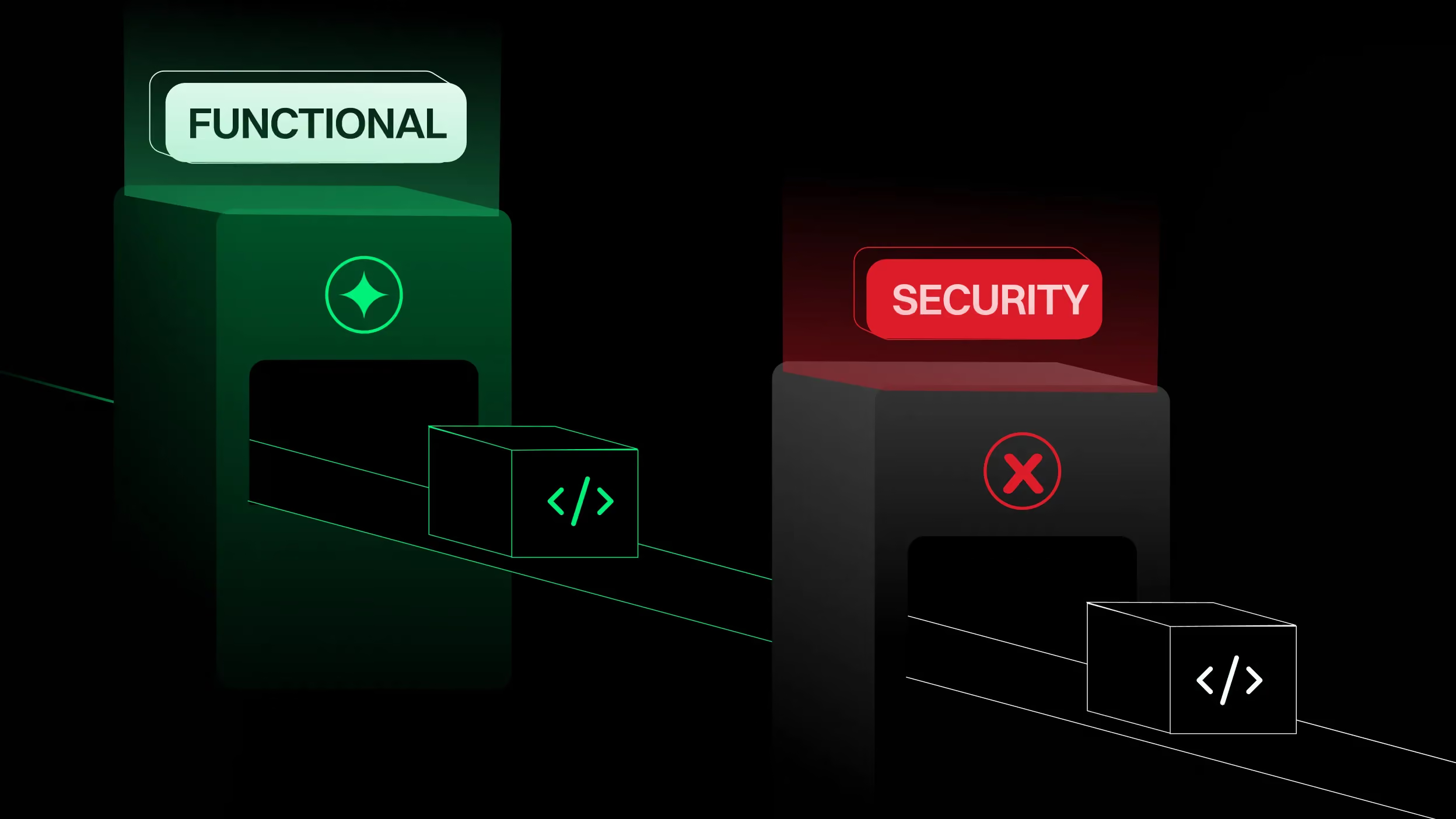



The scan came back clean. No injection, no hardcoded secret, no unsafe deserialization. The code also lets any logged-in user read every other user's records. No rule describes that, because it is not a pattern. It is a decision the model made.
What is SAST for AI-generated code?
SAST for AI-generated code means running static application security testing (SAST) on code written by AI assistants and agents. SAST scans source code for security flaws without running the program. AI-generated code is code produced by tools like coding copilots and coding agents.
AI-generated code is not worse than human code by default. Models learned from human code, so research finds a similar rate of flaws in what they produce. The problem is not that the flaws are new. It is that the volume arrives faster than a code review absorbs it, and the flaws that survive a scanner are the ones that were never pattern-shaped to begin with.
That mix is already shifting, as we established in this previous article. Better prompts and security-focused system prompts will make simple injection and input-handling flaws scarce. What remains are the harder logic flaws, and the findings that look like flaws but are not, because something upstream or downstream already handles them.
AI-Assisted SAST vs. AI-Native SAST
Every buyer runs into two very different things sold under the same label. The difference decides whether the tool can actually reason about AI-generated code.
| Aspect | AI-Assisted SAST | AI-Native SAST |
|---|---|---|
| Where AI sits | Bolted onto a rule-based scanner | Drives detection itself |
| What AI does | Summarizes or triages existing findings | Reasons about code, dataflow, and logic |
| Detection engine | Traditional signature rules | AI analysis plus pattern matching |
| Coverage of logic flaws | Limited to rule patterns | Catches auth and business-logic flaws |
| Trade-off | Easy add-on, same blind spots | Deeper analysis, needs transparent evidence |
AI-assisted SAST is a fast upgrade, but it inherits the blind spots of the rules underneath it. AI-native SAST can follow logic across files, which is where AI-generated code tends to break.
Why AI-generated code overwhelms traditional SAST
For engineering leaders, the appeal of AI coding is simple: more features, shipped faster, with less manual typing. The side effect is a wave of new code hitting your scanner every day.
That wave is real. In Stack Overflow's 2025 developer survey, 84% of respondents are using or planning to use AI tools, an increase over last year (76%). We've compiled a list of the 9 best SAST tools in this article.
More code means more findings. Cloud Security Alliance research found AI-assisted developers committed code at three to four times the rate of non-AI peers. Over six months, monthly security findings rose from about 1,000 to more than 10,000, a tenfold surge.
Four pressures pile up at once:
- Volume floods the queue. A scanner that produced a manageable list now produces thousands of findings a month.
- Provenance is lost. There is no human author to route a finding to, so ownership is unclear.
- Insecure patterns repeat at scale. A model reproduces the same weak pattern across many files.
- Velocity outpaces review. Code merges faster than anyone can triage the results.
This is expensive for developers. An IDC InfoBrief discovered developers lose hours to triage: an average of 3.5 hours per week reviewing scanning findings, many later deemed inapplicable.
So the real problem is not detection. Traditional scanners already find plenty. The problem is triage and validation: sorting the flood down to what actually matters.
The security risks hiding in AI-generated code
The risks fall into two buckets: familiar flaws produced faster, and newer classes that rule-based scanners were never built to see. Both show up in real repositories.
In a peer-reviewed study, around 30% of AI-generated code snippets had security weaknesses related to 43 different CWEs (common weakness enumerations).
Familiar flaws, delivered at machine speed
Most AI-introduced bugs are the same ones humans introduce. When a prompt omits security requirements, the model fills the gap with whatever pattern was most common in training data.
Common examples include:
- Missing input validation on user-supplied data
- SQL and OS command injection
- Cross-site scripting (XSS) in web output
- Broken authentication and access control
- Hard-coded secrets and credentials
Telling the assistant to "write secure code" does not reliably fix this. The model has no view of your application's threat model, so it guesses. See our breakdown of the common vulnerabilities in AI-generated code for the full list.
AI-era risks rule-based scanners miss
Some risks are specific to how AI systems and AI-written code behave. Prompt injection is the clearest example. Prompt injection is when attacker-controlled text tricks a large language model (LLM) into unsafe actions.
OWASP lists prompt injection as LLM01, the top risk in OWASP's Top 10 for LLM Applications for 2025. Signature rules cannot see it, because the "input" is natural language flowing through application logic. Our guide to detecting prompt injection walks through what to look for.
Two more classes matter here. Hallucinated or outdated dependencies happen when a model suggests packages that are unsafe or do not exist, a pattern often called slopsquatting. Design drift happens when AI copies an insecure architecture that looks correct but quietly breaks a security invariant, as we cover in architectural design flaws.
How AI SAST works under the hood
The mechanism is what separates real AI SAST from a marketing label. The three parts below are simple once you name them plainly.
Each part answers a practical question: what did we find, does it matter, and can we trust the fix.
Context-aware detection and multi-file dataflow
Detection starts by parsing code and matching known-risky patterns. Then the analysis traces dataflow, the path that data travels through a program.
Two terms make this concrete. A source is where untrusted input enters, such as a web request. A sink is a dangerous operation, such as a database query or a shell command.
The value is following that path across many files and functions, not just one. That multi-file view is how a scanner catches auth and business-logic flaws that single-file rule engines never connect.
Reachability: separating exploitable vulnerabilities from noise
Reachability answers one question: can a vulnerable path actually be reached and triggered from a real entry point. If nothing untrusted can reach the flaw, it is far lower priority.
This is the antidote to the finding flood. J.P. Morgan notes that only a small fraction are ever exploited, historically 1.5% to 2.0% of reported vulnerabilities each year.
Prioritizing by full stack reachability means developers see fewer, realer findings. To go deeper, read our overview of the types of reachability analysis.
Evidence-based remediation you can trust
Finding an issue is only half the job. Autofix alone is risky, because AI-generated fixes are often wrong or introduce new bugs.
The numbers back this up. A 1Password study found only 26% of LLM-generated patches fully fixed the flaw without side effects, and 53.9% were flawed.
A trustworthy fix comes with evidence: the dataflow path, the reason it is a problem, and a change you can verify. Validation, not detection, is the real bottleneck.
What to look for in AI SAST
Use this checklist to evaluate any AI SAST tool. Each row turns a common vendor claim into a question you can test.
| What to Check | Why It Matters |
|---|---|
| Is AI in detection or bolted on? | Bolted-on AI inherits the rule engine's blind spots. |
| Are false positives cut with evidence? | Evidence beats confidence scores you cannot audit. |
| Does it trace multi-file dataflow and reachability? | This is where AI code and logic flaws hide. |
| Does it catch auth, logic, and prompt injection? | AI-era classes need reasoning, not signatures. |
| Does it fix at the source, in the IDE or PR? | Fixes where developers work reduce context switching. |
| How many languages does it cover? | Polyglot AI codebases need broad support. |
| Is detection reproducible and auditable? | You need to defend findings to teams and auditors. |
How Endor Labs approaches SAST for AI-generated code
Endor Labs runs pattern-based detection with Opengrep, then uses AI agents to triage each finding. The agents trace dataflow from source to sink, check sanitizers and controls, and classify each finding as a true or false positive with transparent evidence.
For developers, that means fewer, realer findings and fixes offered inside AI code editors. The analysis works across multiple files and functions, surfaces reachable auth and business-logic flaws, and detects prompt injection with no new rules, across 40+ languages. You can see the scope in Endor Labs AI SAST.
The results are measurable. In our AI SAST benchmark, Endor Labs AI SAST found 2.6x more real vulnerabilities than frontier AI models. The same flow-based analysis discovered a zero-day, CVE-2026-55407, in Anthropic's Rust buffa library.
Dependencies get the same scrutiny. Endor Labs research found only 1 in 5 AI-recommended dependency versions is safe, and 34% are hallucinated. That is why validation matters as much as detection.
Frequently Asked Questions
What is the difference between AI SAST and traditional SAST?
Traditional SAST matches code against fixed signature rules. AI SAST adds reasoning that traces dataflow across files and triages findings, catching logic flaws and cutting false positives.
Is AI-generated code less secure than human-written code?
Not inherently. It carries the same flaw rate as the human code it learned from, and it ships far faster, so insecure patterns spread more quickly.
Can AI SAST catch prompt injection and other AI-era risks?
Yes. AI SAST that reasons about dataflow and logic can detect prompt injection, which OWASP ranks as the top LLM risk, plus related AI-era weakness classes.
Does AI SAST eliminate false positives?
No tool eliminates them entirely, but reachability analysis and evidence-based triage sharply reduce noise by surfacing findings that are actually reachable and exploitable.
Where in the SDLC should SAST run for AI-generated code?
Run it where developers already work: in the IDE and AI code editor, on every pull request, and in CI. That way issues are caught before they merge.
Is SAST enough on its own to secure AI-generated code?
No. Pair it with software composition analysis (SCA), which scans dependencies, since AI often suggests hallucinated or outdated packages that SAST alone will not flag.
Where to go from here
Securing AI-generated code does not require slowing developers down. It requires a short, practical sequence:
- Treat AI-generated code as untrusted, and run SAST built to reason about it.
- Prioritize by full stack reachability, so the queue reflects real, exploitable risk.
- Require evidence-backed fixes, not blind autofix, so remediation holds up.
- Put detection and fixes in the IDE and pull request, so developers stay in flow.
Do these four things and AI code becomes a speed advantage instead of a review backlog. To see reachability-based triage and evidence-based fixes on your own code, Book a Demo.
What's next?
When you're ready to take the next step in securing your software supply chain, here are 3 ways Endor Labs can help: