Secrets Detection

Find the leaked secrets that are actually live
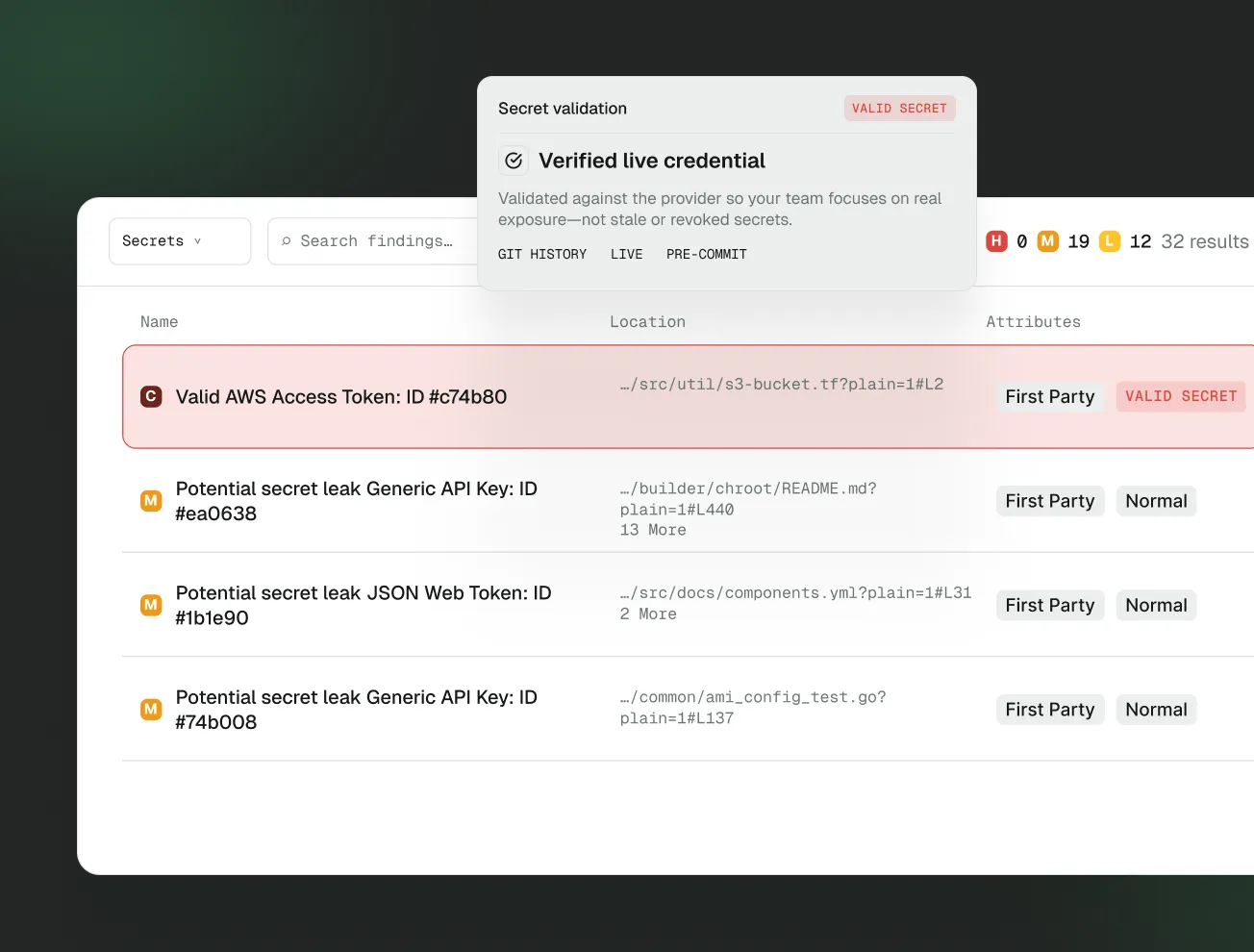
Secrets Detection scans your full Git history for leaked credentials, validates findings as live or revoked, and stops new leaks at pre-commit, so your team only chases real exposure.
Secrets findings list highlighting a verified live AWS access token among potential secret leaks

How Secrets Detection works

Find secrets that are actually live
Pattern-matching scanners flag any string that looks like a secret, including test fixtures, example values, and credentials rotated months ago. Secrets Detection validates each finding as Valid, Invalid, or Unvalidated by calling the underlying service, so your team only spends time on live exposure.
Scan your entire Git history
A scanner that only checks the default branch misses the leak that lived briefly in a feature branch and then disappeared. Secrets Detection scans every branch and commit, and deduplicates the same secret across all files into one finding with every location attached.
Stop new leaks at pre-commit
A leaked secret is among the cheapest attacks in the playbook and one of the most expensive incidents, averaging $1.2M per leak, and 80% of teams admit they aren't managing secrets well. Pre-commit hooks block new secrets before they ever reach production.
“Endor Labs helped us cut through the noise and focus on what matters. With fewer alerts and more accuracy, our teams now spend more time building and less time chasing false positives.”
Michael Hammond

Information Security Engineer, Zebra Technologies

Git history diagram showing an AWS key leaked in a merged-then-deleted branch, scanned across every repo, branch, and commit
Full-history scanning
Scan the complete Git history of every repository, every branch and every commit, not just the default branch where leaks rarely live.
Scan complete Git history across every branch and commit, including leaks that lived briefly in a feature branch.
Use out-of-the-box rules for AWS, GitHub, GitLab, and other public services.
Add custom rules for the bespoke tokens unique to your environment.
Learn more
Live-credential validation
Validate each finding by calling the underlying service, so a finding means a live credential, not just a string that looks like one.
Classify every finding as Valid, Invalid, or Unvalidated by calling the service (AWS, GitHub, GitLab, and more).
Focus the team only on credentials that are confirmed live.
Stop burning hours chasing findings that turn out to have been revoked months ago.
Learn more
Secret finding detail for a validated live AWS access token with location and finding policy
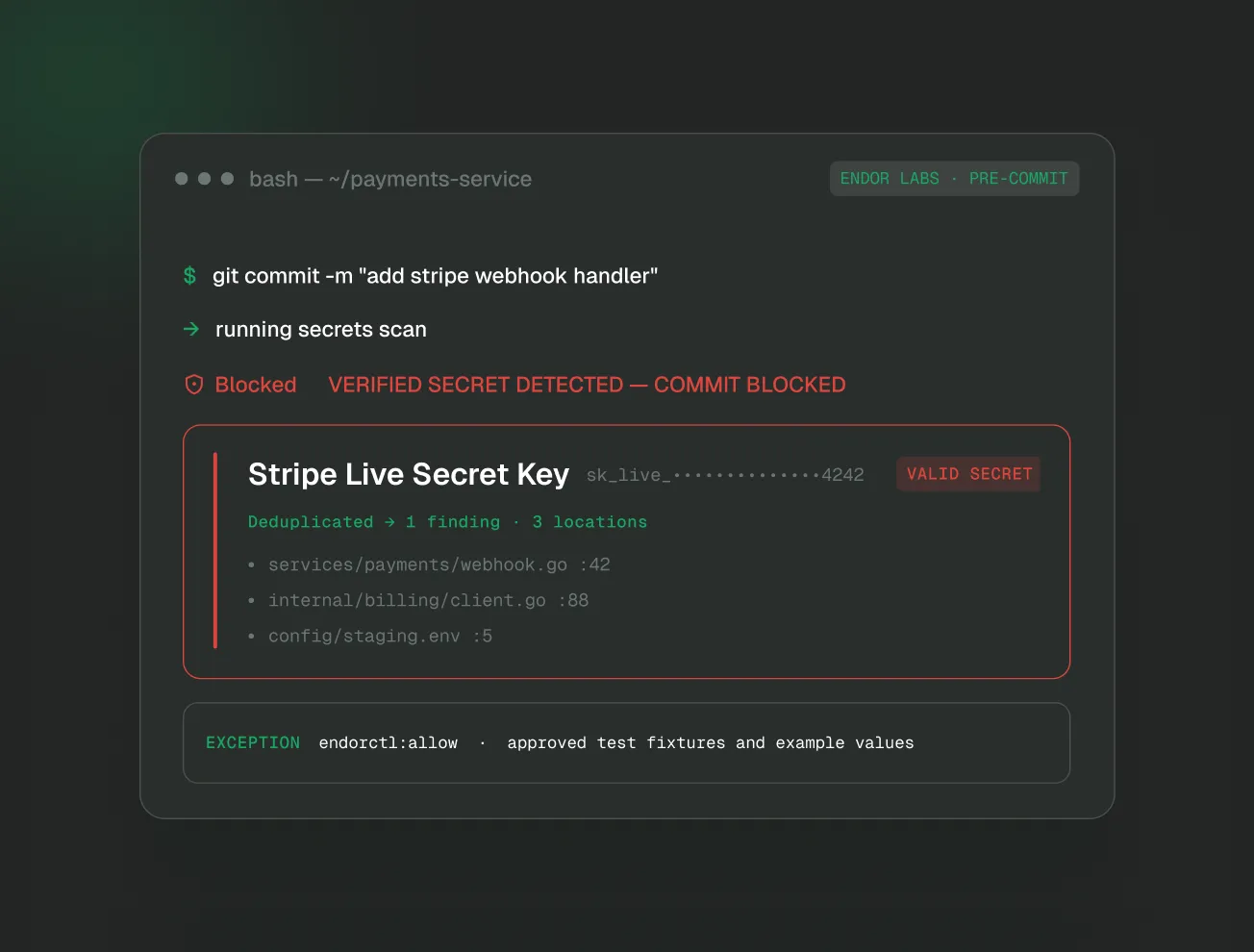
Pre-commit secrets scan blocking a commit after detecting a verified Stripe live secret key
Pre-commit prevention
Block new secrets before they reach the remote, deduplicate noise, and give developers an exception path that doesn't require a ticket.
Block new secrets at the pre-commit hook so they never reach the remote in the first place.
Deduplicate the same secret across all files into one finding with every location attached.
Let developers mark test fixtures and example values with endorctl:allow for an exception workflow that skips the Jira ticket.
Learn more
Flowchart showing integration paths from GitHub, GitLab, and PHP to Slack and Microsoft platforms, with a C# icon connected to Slack.

Your Tools, Your Languages
All Secured

Learn how Endor Labs fits into your ecosystem.
Flow diagram connecting software development tools and platforms including .NET, JetBrains, GitHub, Google, and Vercel.

FAQs

How is this different from a pattern-matching secret scanner?

Pattern matching flags any string that looks like a secret, including test fixtures and rotated credentials. Secrets Detection validates each finding against the underlying service, so you act only on credentials that are actually live.

Does it scan the whole Git history or just the latest commit?

It scans the complete Git history, every branch and every commit, so it catches leaks that lived briefly in a feature branch and then disappeared, not just what's on the default branch today.

How does it cut down on duplicate alerts?

Deduplication groups the same secret appearing across many files into a single finding with all locations attached, so the same credential in 50 files is one item to fix, not 50 alerts to triage.

Can we stop leaks before they happen?

Yes. Pre-commit hooks block new secrets before they reach the remote. Secrets Detection also runs on a specific commit during CI and across full repository history during audit.

What about test fixtures and example values that aren't real secrets?

Developers can mark those with endorctl:allow for an informed exception workflow, so known-safe values don't generate findings and don't require a ticket for every false positive.

Does it cover credentials specific to our environment?

Out-of-the-box rules cover public services like AWS, GitHub, and GitLab, and custom rules cover the bespoke tokens unique to your environment.

Code without compromise