Software Supply Chain Security

Secure your software supply chain for the AI era.
AI coding agents, developer machines, code repositories, and CI/CD pipelines are all targets for software supply chain attacks. 
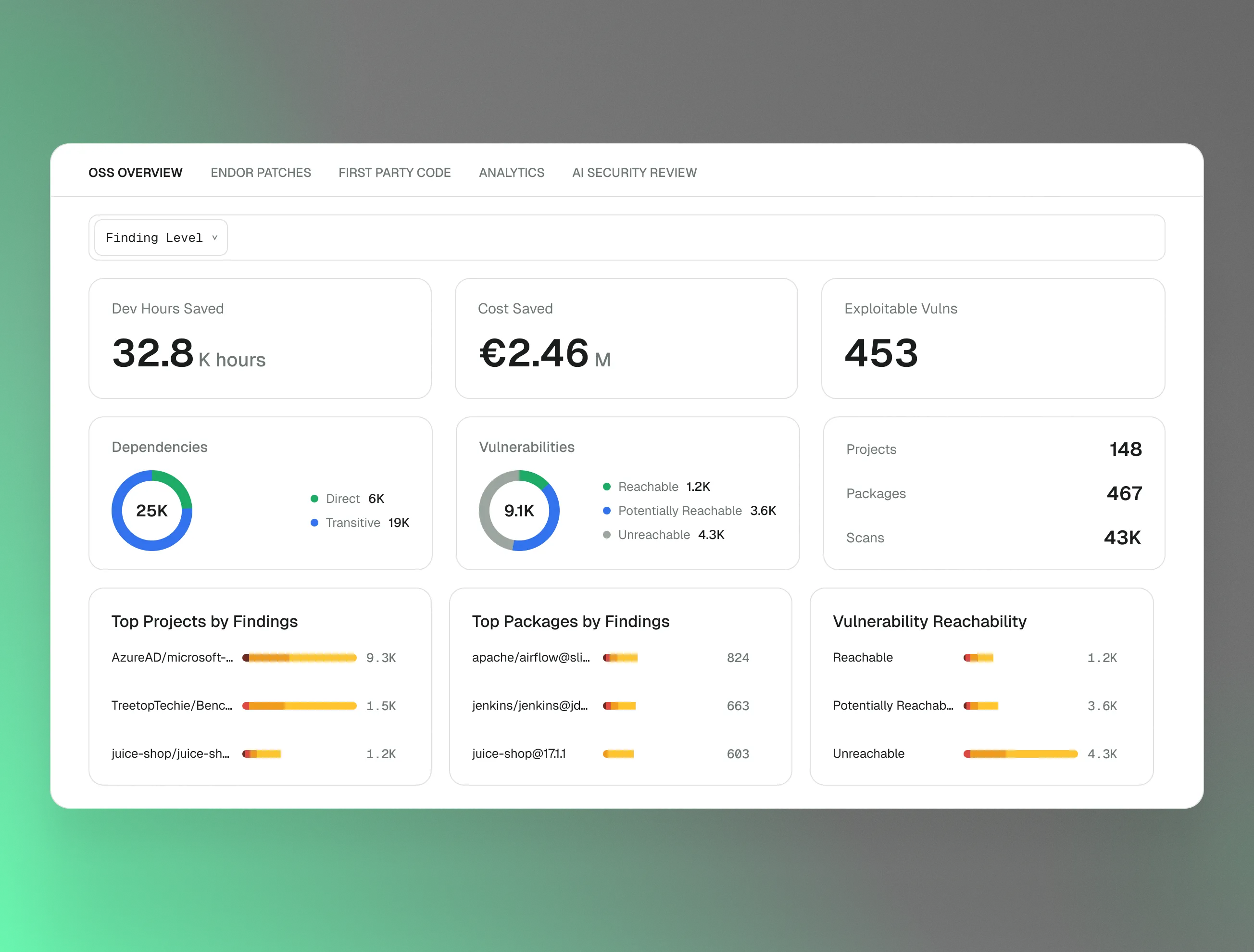
OSS overview dashboard showing developer hours saved, cost saved, exploitable vulnerabilities, and reachability breakdown
Loved by security teams, painless for developers at:

How software supply chain security works

Block malicious packages before they enter your environment
Malicious packages land on npm and PyPI every day, and AI coding agents install dependencies without human review. Legacy SCA scans after the install — Endor Labs blocks malware, typosquats, and dependency confusion at the registry edge, before a package reaches a workstation or pipeline.
Cut vulnerability backlogs to what attackers can actually reach
Attackers weaponize critical CVEs in days, while AppSec teams chase thousands of findings that are not reachable from any code path. Reachability analysis filters the backlog to real risk, and upgrade impact analysis and backported patches give teams a safe path to fix it — without breaking the application.
Harden the CI/CD pipeline attackers are now targeting
GitHub Actions workflows pull in untrusted actions, expose secrets in logs, and run with more privilege than they need — and most teams have no inventory of any of it. Endor Labs maps every workflow, action, and secret, then enforces hardening policies across every repo.
“Over 97% of vulnerabilities flagged by our previous tool weren't reachable in our application. Endor Labs shows the few impactful vulnerabilities, so we can patch quickly, focusing on what matters.”
Travis McPeak

Security Lead, Cursor (Anysphere)

SCA findings with dependency path tracing a reachable vulnerability from the application to jackson-databind
Full-stack reachability for apps and container images
See and rank every component in the supply chain on a single risk surface, with function-level reachability across first-party code, OSS, containers, and AI models.
Function-level reachability helps prioritize reachable and exploitable vulnerabilities across dependencies and container images
Find, inventory, and assess AI models and services for risk, and report them in your software bill of materials (SBOM)
Learn more
Agentic remediation
Close the loop on every vulnerability with upgrade risk analysis, merge-ready pull requests, and backported patches that fix CVEs without forcing a breaking change.
Upgrade Impact Analysis assigns each fix a High, Medium, or Low risk score before any code change.
Automated remediation PRs for Java, Go, Python, .NET, and JavaScript, opened directly in GitHub.
Endor Patches backport security fixes as hermetic, reproducible artifacts when full upgrades are too disruptive.
Learn more
Agentic remediation dashboard listing merge-ready dependency upgrade pull requests
Package Firewall dashboard showing npm packages blocked for malware
Detect and block malicious OSS packages
Block malicious open source dependencies before they enter the codebase, with real-time scanning of every newly uploaded package on npm, PyPI, Maven Central, and other registries.
150+ supply chain risk signals combining SAST rules, malware signatures, and behavioral analysis.
Cooldown policies hold new packages out of builds for a configurable window, the riskiest period for malware distribution.
CI/CD enforcement blocks compromised packages with no repository proxy required.
Learn more
GitHub Actions security
Apply the same dependency analysis, reachability, and risk scoring to GitHub Actions workflows, so CI pipelines are governed with the same rigor as application code.
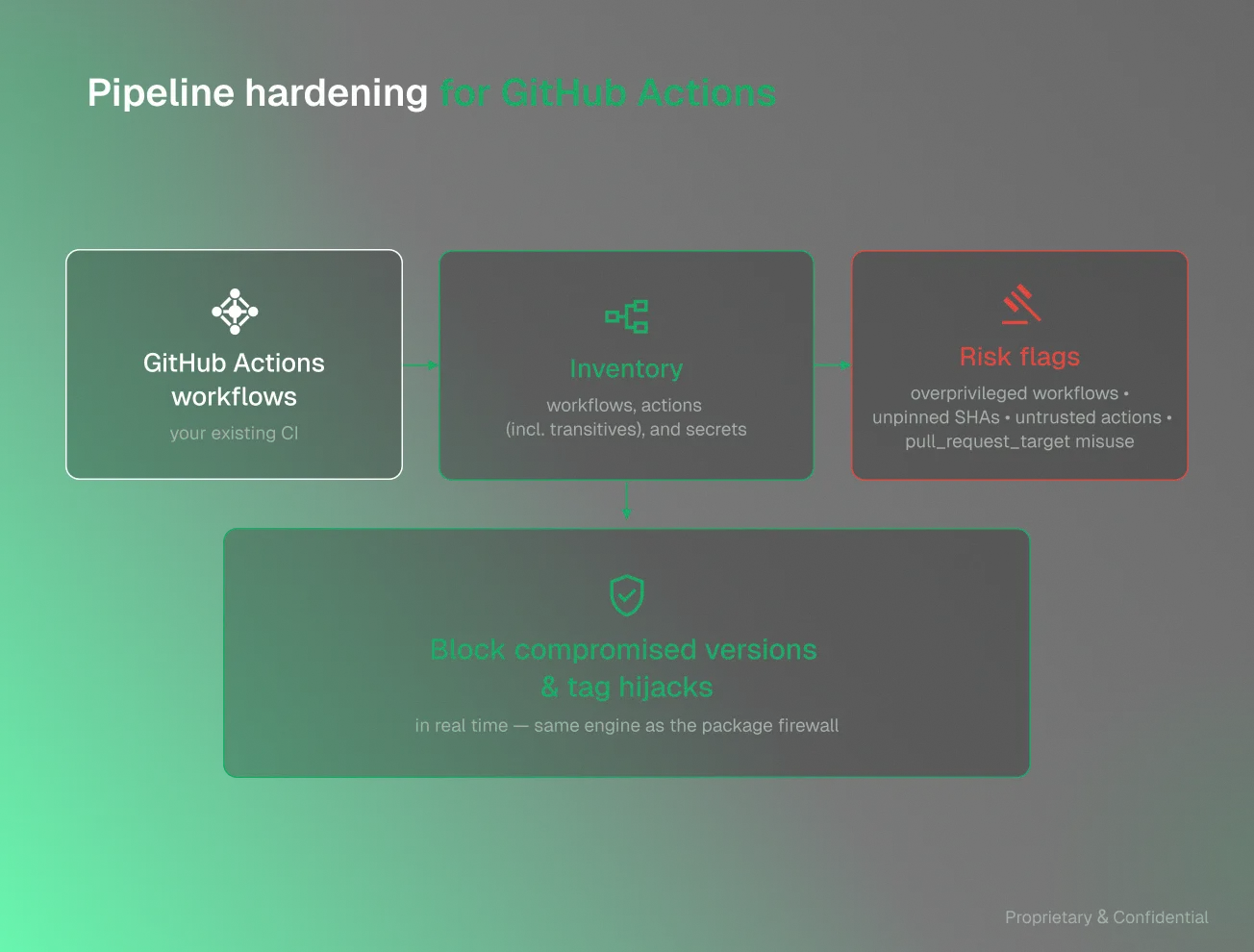
Discover every Action across the org, including transitives, with version pinning and SHA hygiene on one dashboard.
Detect dangerous workflow patterns: pull_request_target misuse, untrusted input in shell commands, overly broad permissions.
Block compromised Action versions and tag hijacks in real time, the same way the package firewall handles npm and PyPI.
Read the docs
Pipeline hardening for GitHub Actions diagram showing workflow inventory, risk flags, and blocking of compromised versions and tag hijacks
Flowchart showing integration paths from GitHub, GitLab, and PHP to Slack and Microsoft platforms, with a C# icon connected to Slack.

Your Tools, Your Languages
All Secured

Learn how Endor Labs fits into your ecosystem.
Flow diagram connecting software development tools and platforms including .NET, JetBrains, GitHub, Google, and Vercel.

FAQs

How is reachability-based prioritization actually different from CVSS or EPSS?

CVSS and EPSS describe a vulnerability in the abstract. Reachability describes whether your application can actually invoke the vulnerable function. Endor Labs builds a function-level call graph across 40+ languages and traces paths from your first-party code through direct and transitive dependencies to known vulnerable functions. If no path exists, the finding is labeled unreachable and you safely deprioritize it. Customers typically see an average 92% reduction in actionable findings.

How quickly does the package firewall block a newly published malicious package?

Every new version published to npm, PyPI, and other major registries is scanned within minutes against 150+ supply chain risk signals: SAST rules for dangerous code patterns, malware signatures for known threats, and behavioral analysis for typosquats and anomalous publication activity. Cooldown policies hold new packages out of builds for a configurable window so the highest-risk early hours of a package’s life are covered even before automated analysis completes.

How do Endor Patches differ from a regular dependency upgrade?

A full version upgrade brings every change between your current version and the latest, including new features, API changes, and behavioral modifications alongside the security fix. Endor Patches identify the specific commits that resolved the vulnerability, backport those commits onto your current library version, and produce a hermetic, reproducible artifact. You get the security fix without the breaking changes. Snyk applies patches as code-level modifications; Dependabot and Renovate cannot patch at all.

Does the SBOM meet regulatory and customer requirements?

Yes. SBOM Hub generates and ingests SBOMs in CycloneDX and SPDX formats across multiple versions, aligned to NIST SSDF, SLSA, CIS, EO 14028, FedRAMP, and PCI DSS. Every VEX document includes reachability-based exploitability for each CVE, so auditors and customers see which vulnerabilities can actually be invoked in your application rather than a flat list of theoretical risks.

What languages and runtimes does AI Model Discovery cover today?

AI Model Discovery scans Python applications for AI model loading patterns, Hugging Face references, and local model files. Every discovered model on the Hugging Face platform is scored on 50 metrics across security, quality, popularity, and maintenance activity. Coverage will expand as the open source AI model ecosystem matures; today, Python plus Hugging Face captures the majority of production usage we see in customer environments.

How does GitHub Actions security fit alongside our existing SCA program?

It runs on the same platform, with the same evidence model, the same policy engine, and the same dashboard. Endor Labs discovers every Action used across the organization (including transitives invoked by composite Actions), scores each Action across security, popularity, quality, and activity, detects dangerous workflow patterns like pull_request_target misuse and overly broad permissions, and blocks compromised Action versions in real time. No separate CI security tool to stand up.

Code without compromise