AI Model Governance

Govern open source AI models like every other dependency
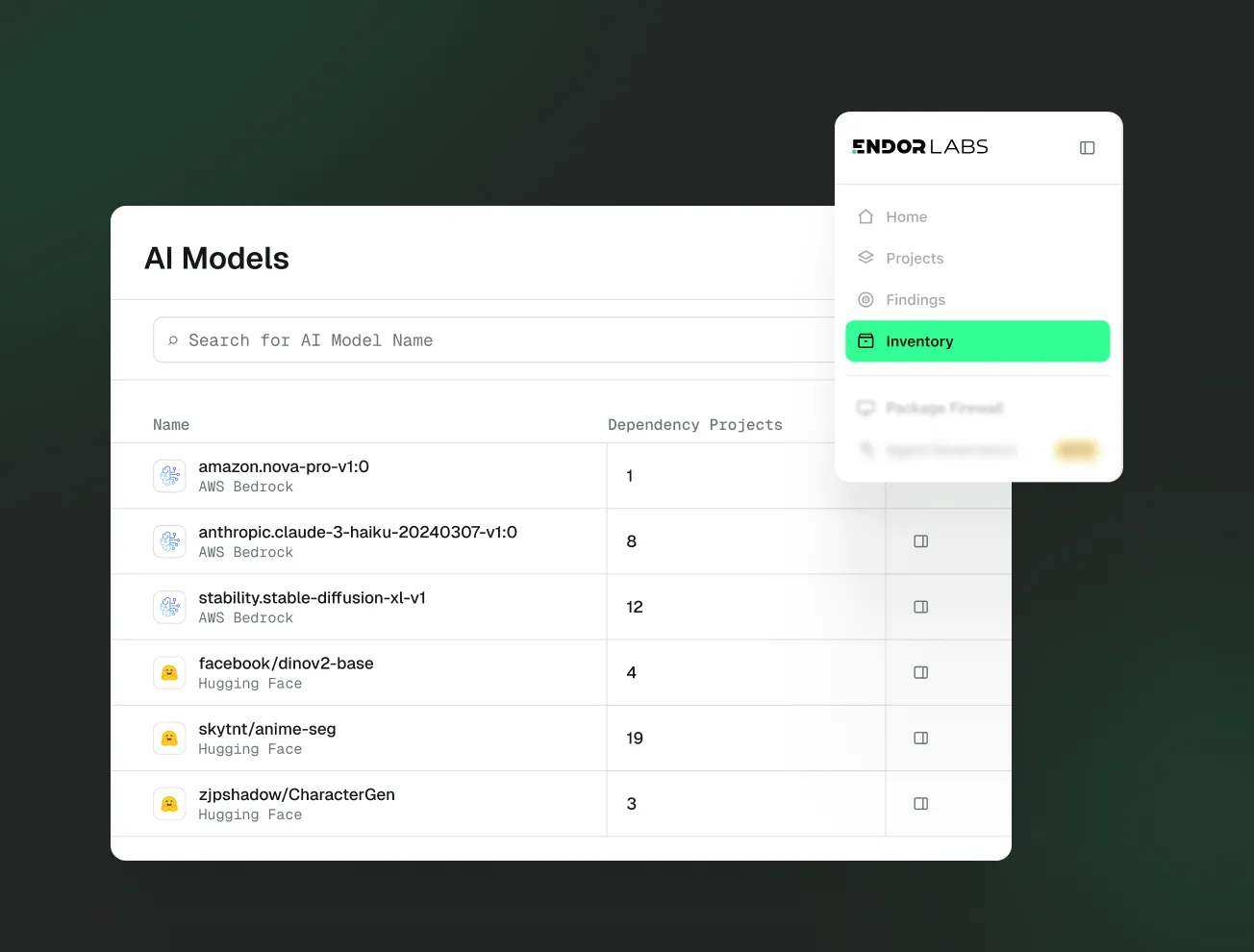
Developers pull open source AI models into production the same way they pulled in open source libraries a decade ago — with no security review. AI Model Governance gives AppSec teams a full lifecycle to discover, evaluate, and enforce policy on those models, inside the same platform they already use for open source dependencies.
Loved by security teams, painless for developers at:

How AI Model Governance works

Discover the AI models entering your codebase
Developers pull AI models from Hugging Face straight into application code, and traditional SCA tools never detect them — so they never reach your inventory or SBOM. AI Model Governance finds them automatically on every scan and keeps an audit-ready record of which models run in which applications, without relying on developer self-reporting.
Evaluate AI models before they ship to production
Open source AI models carry the same risk dimensions as any other dependency — security, license, maintenance, and provenance — plus unsafe formats like pickle and unverified PyTorch that can execute code when a model loads. AI Model Governance scores each model against those signals so teams can decide before a feature is built on it.
Enforce policy on AI model adoption without slowing developers
Standalone AI security tools force a separate set of policies, alerts, and workflows, and approving models by hand in spreadsheets and tickets doesn't scale. AI Model Governance applies consistent policy inside the AppSec workflows you already run, so AI features ship without a new review bottleneck.
“Endor Labs' unique reachability-based analysis and native integrations into our agentic software development stack keep our developers focused on rapidly finding and fixing real risks in the SDLC, so we ship faster with confidence.”
Sunil Agrawal Photo
Sunil Agrawal
CISO, Glean
Model discovery
Detect the open source AI models running in your applications automatically, as part of every scan.
Detect open source AI models used in your applications automatically as part of every scan.
Report AI model usage in your SBOM alongside every other open source dependency.
Maintain an audit-ready record of which models are in which applications, without relying on developer self-reporting.
Learn more
Risk evaluation
Score every AI model across the security, licensing, and operational-quality signals that decide whether it's safe to adopt.
Score every AI model from Hugging Face across 50+ signals spanning security, licensing, popularity, activity, and operational quality.
Catch unsafe file formats like pickle and unverified PyTorch that can execute code when a model loads.
Flag typosquatting, restrictive licenses, and abandoned models before developers commit to them.
Learn more
Policy enforcement
Define AI model policy once and enforce it everywhere, using the same engine that powers the rest of Endor Labs.
Define AI model policies once and enforce them everywhere — warn developers in the IDE or block risky models from reaching CI.
Use pre-built policies for common risks or write custom rules with the same Open Policy Agent engine that powers the rest of Endor Labs.
Govern AI models inside the platform AppSec teams already run for SCA — no separate tool, no separate workflow.
Learn more
Flowchart showing integration paths from GitHub, GitLab, and PHP to Slack and Microsoft platforms, with a C# icon connected to Slack.

Your Tools, Your Languages
All Secured

Learn how Endor Labs fits into your ecosystem.
Flow diagram connecting software development tools and platforms including .NET, JetBrains, GitHub, Google, and Vercel.

FAQs

What is AI Model Governance?

It's the AI dependency layer of the Endor Labs platform. It treats open source AI models like any other software dependency, applying a full lifecycle of discovery, evaluation, and policy enforcement from inside the same platform AppSec teams already use for SCA.

Why can't our existing SCA tools handle AI models?

Traditional SCA tools don't detect AI models as dependencies, so the models developers pull from Hugging Face never show up in your inventory or SBOM. AI Model Governance discovers them automatically and governs them alongside every other dependency.

What do you evaluate each model for?

Every model is scored across 50+ signals spanning security, licensing, popularity, activity, and operational quality — including unsafe file formats like pickle and unverified PyTorch that can execute code when a model loads, plus typosquatting, restrictive licenses, and abandoned models.

Which models does it cover?

It discovers the open source AI models used in your Python applications and evaluates models from Hugging Face against the full set of risk signals.

How does it enforce policy without slowing developers down?

You define AI model policy once and enforce it everywhere — warning developers in the IDE or blocking risky models before they reach CI — using the same Open Policy Agent engine that powers the rest of Endor Labs. Routine approvals happen automatically instead of one ticket at a time.

Do we need a separate tool for this?

No. AI Model Governance runs inside the Endor Labs SCA platform, so you govern AI models with the same workflows, policy engine, and SBOM you already use for open source dependencies — no separate product, policies, or alerts to manage.

Code without compromise