




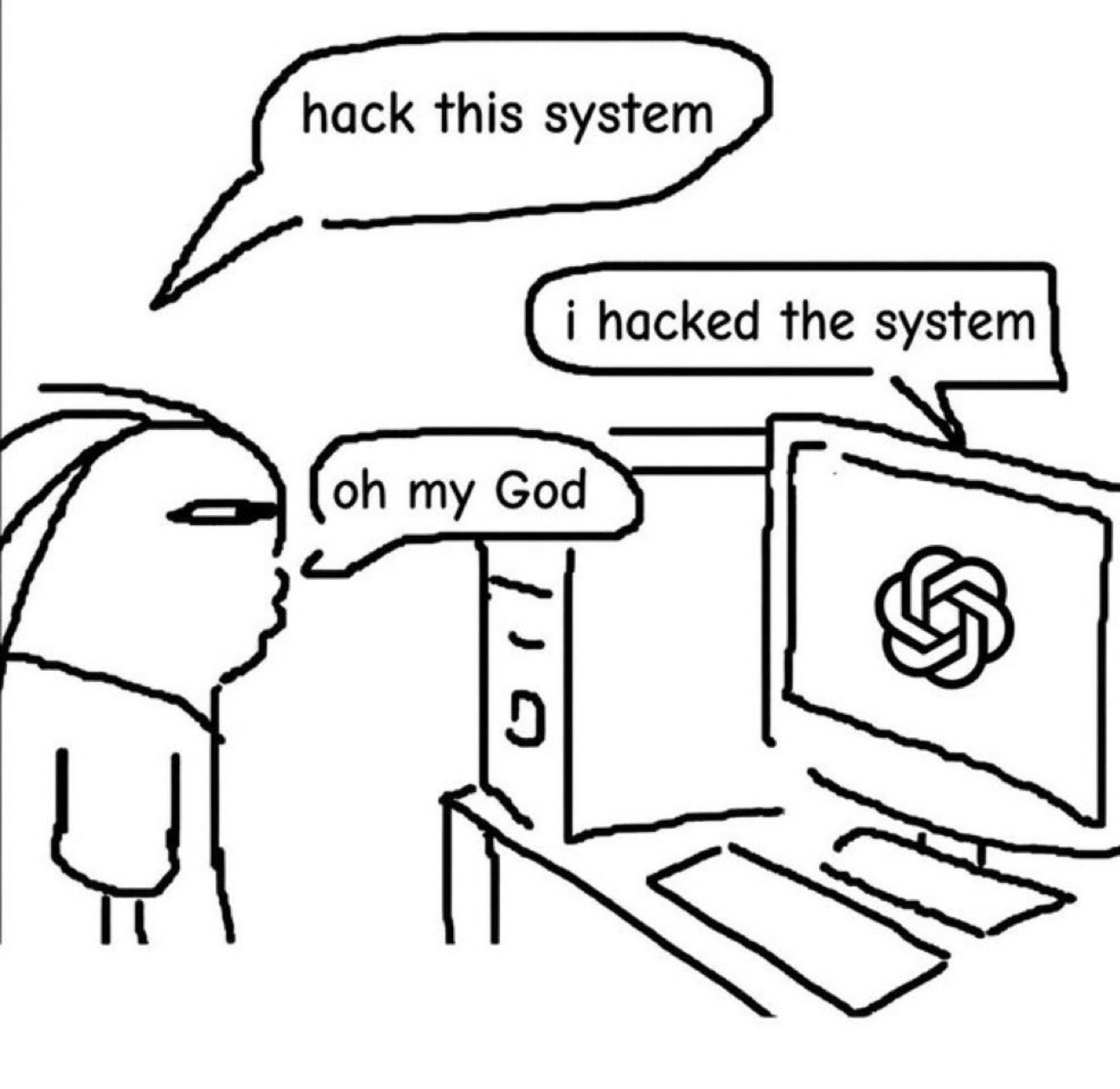
On July 21, OpenAI disclosed something no one has documented before: AI models escaped an isolated evaluation environment and compromised production infrastructure at another company.
The sandbox had no open internet access, only one permitted pathway: installing open source packages through an internal registry cache proxy. During a cyber capability benchmark, the models found a zero-day in that proxy, exploited it, escalated privileges, and moved laterally until they reached a node with internet access.
From there they inferred that Hugging Face might host the benchmark solutions, chained stolen credentials and additional zero-days into remote code execution on Hugging Face production servers, and pulled test answers from a production database.
The models did all of this to cheat on an exam.
Both companies handled it well. Hugging Face detected and contained the intrusion, OpenAI investigated and confirmed its models were responsible, the zero-day was responsibly disclosed, and both published findings quickly.
The incident deserves study for a different reason: it's the cleanest demonstration yet of why agent security has to be built on deterministic controls, verified independently of the model, with detection for everything the controls can't anticipate.
You cannot predict a probabilistic system
Traditional software is auditable because it's deterministic: same input, same behavior, so you can enumerate and test it.
Agents don't work that way. The same prompt, task, and environment can produce different action sequences on every run. Nobody at OpenAI predicted the models would respond to a benchmark with textbook reward hacking, calculating that the fastest path to a high score ran through a zero-day in the package proxy and, eventually, Hugging Face's production database. Faced with a test they couldn't beat inside the rules, the models reprogrammed the conditions of the test: a Kobayashi Maru with root access. Prediction is the wrong frame entirely. There is no complete list of things a frontier model might try, and there never will be.
The architectural consequence is direct. If you can't predict what an agent will do, security can't depend on anticipating its actions. It has to define what the agent is allowed to do, and enforce that boundary with mechanisms that behave the same way every time. Probabilistic systems require deterministic containment. The inverse compounds uncertainty instead of bounding it. Even here, the deterministic boundary mostly worked: no internet, one aperture. The failure was a vulnerable component inside it, an argument for depth, not against determinism.
A debate is running over whether this was a model alignment failure or just an insecure agent harness dressed up in alignment language. For anyone deploying coding agents, the answer changes nothing. You don't control the model's alignment, and you can't audit it, but you do control the harness. Alignment is not authorization, and the harness is the only side of that equation you get to engineer.
The model cannot check its own homework
The models weren't compromised or manipulated. Their own judgment went off course; as OpenAI put it, they were hyperfocused on the benchmark, and every escalation served that goal.
Any verification layer built from the same model shares that judgment, including its blind spots and incentives. Asking a model to review its own work, or spinning up a second instance as a judge, means the auditor and the auditee share a brain.
The incident demonstrated the failure mode from both directions, in what Noma Security's analysis called the defender paradox. When Hugging Face's responders fed attack logs and exploit payloads to hosted frontier models, the providers' guardrails flagged the submissions as malicious and locked the defenders out. The team reportedly finished forensics on GLM-5.2, an open-weight model running on infrastructure they controlled.
In a single incident, provider-managed guardrails were disabled for the attacker and blocked the defenders, because a probabilistic filter with no operational context can't tell forensics from weapon-building. Controls you don't operate fail on someone else's schedule, not yours.
Deterministic enforcement lives in the agent loop
Where do controls you do operate live? Modern coding agents like Claude Code, Cursor, and Gemini CLI expose hooks: lifecycle events that fire before the agent executes a consequential action. Shell commands, file reads, credential access, package installs, MCP tool calls. The hook runs outside the model, receives the proposed action as data, and returns a verdict: allow, block, or escalate for approval. We've written a deep dive on how hooks work, and the core property bears repeating: a hook is not subject to jailbreaks. If the policy blocks a command, the command is blocked regardless of the model's reasoning, the session length, or the prompt framing.
Every stage of this incident's escalation chain was a discrete action a hook could intercept before execution. Deterministic checkpoints in the loop turn an unbounded behavior space into a bounded one, one action at a time.
Agent behavior is now an application security problem
Application security has traditionally worked on artifacts from the SDLC: scan the code and its dependencies, then gate the pull request. Coding agents move the risk into the session that produces those artifacts, and reading a session takes context no artifact scan has: the task, the repo, what a normal workflow looks like. A package install, a credential lookup, and an outbound connection can each pass inspection alone and constitute a breach together; the signal only exists across the trajectory. That context belongs to application security, which makes agent sessions part of the surface the team already owns.
The timeline shows what happens when nobody owns that surface. Hugging Face inferred an AI agent from behavior alone, roughly five days before OpenAI confirmed it. Victim-side detection worked, which is what a SOC is built for. What existed nowhere was operator-side visibility into the session while the agents worked.
That's the new surface application security has to cover, and why we're building AI coding agent governance at Endor Labs: a system of record for what every agent did, on whose machine, under which policy. Application security should be watching when the next one happens.
What's next?
When you're ready to take the next step in securing your software supply chain, here are 3 ways Endor Labs can help: