







Today, Endor Labs is adding sandbox posture to Coding Agent Governance: a report of whether the sandbox was on for every coding agent session. It matters because when the sandbox is off, nothing stops the agent: it runs with everything that the developer can reach, and nobody is told. It is included for every Coding Agent Governance customer, with nothing new to install.
Policy is one layer
Coding Agent Governance started in the developer loop. It runs as a hook inside the coding agent and checks each action against policy on the developer's machine, before it runs. That layer is precise. It knows the difference between git push and git push --force, and it can ask instead of block. It is a guardrail, though. It stops only what a rule names, and if the hook cannot run, the action proceeds.
The sandbox sits underneath it. The operating system enforces it on every command, named by a rule or not. Writes stay in the project and the network stays on the allowlist. Reads are mostly not restricted.
If policy gives you precision, the sandbox establishes the floor. Governing the agent without seeing the sandbox is governing half of what happens on that machine, and the sandbox is the first layer outside the hook that Coding Agent Governance now reports on.
What's new
In the Inventory section, the Sandboxing view shows one row per developer: the agents they use, their session count, and their sandbox coverage. Coverage is the share of that developer's sessions that had the sandbox on. The Sandbox Gap widget on the Overview lists everyone below 100%, so the people to talk to are the first thing you see. A session where the agent could not determine its sandbox setting counts as unknown and also pulls a developer below 100%, so a gap can be a reporting question as well as a sandbox question.
The same hook that governs tool calls reads the coding agent's sandbox setting at session start, whether it was set for the project, the user, or the whole organization, and reports whether the sandbox was on.
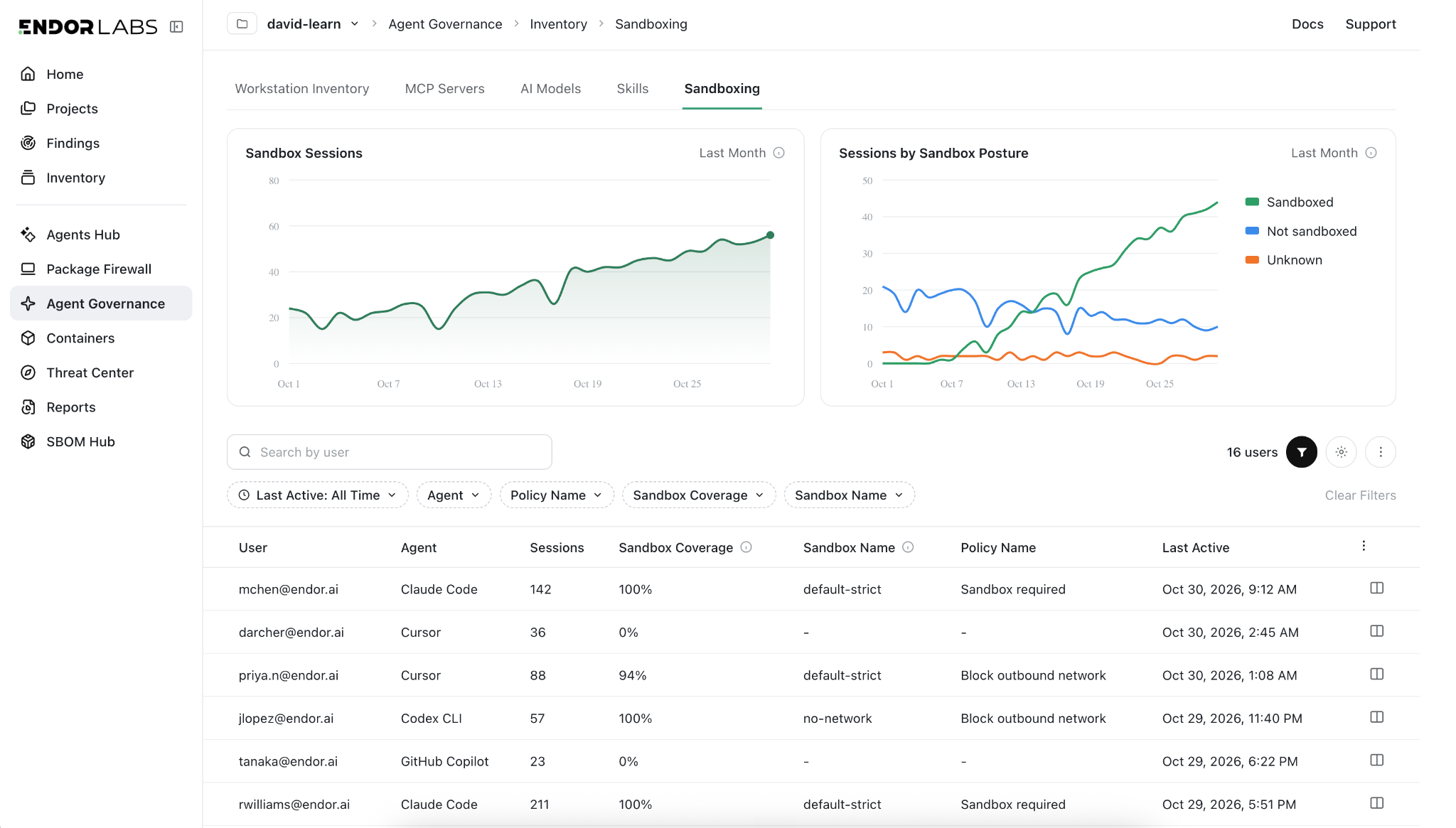
Posture is the sandbox setting in effect when the session started. It is not a trace of what each command did inside it, and it is not a sandbox of our own. The agent brings the sandbox, and its vendor's docs say what it confines. We report whether it was on.
What to do with it
The number is a starting point. Some teams will take it to the developers whose sessions ran with the sandbox off, and find that it was off for a reason better fixed in the setting than with the developer. Others will put policy behind it: Coding Agent Governance ships a session policy that alerts when a session starts without a sandbox, and one that blocks it. The sandbox itself stays the agent's to enforce. Our part is knowing when it was on, and giving you a way to act when it was not. Coverage also gives security leaders one number to track across the organization: the share of coding agent sessions that run inside an OS-enforced boundary.
Getting started
Sandbox posture is included for every Coding Agent Governance customer. Book a demo and we will show you the gap on live data. If you already run Coding Agent Governance, the docs for the Sandboxing view cover supported agents and setup.
What's next?
When you're ready to take the next step in securing your software supply chain, here are 3 ways Endor Labs can help: