





The reason is no secret. AI models are finding and weaponizing vulnerabilities faster than traditional patch cycles can absorb. J.P. Morgan reported earlier this year that vulnerability discovery is outpacing remediation by 16.5x, and FedRAMP's own notice points to last month's "Black October" as the moment that threat hit home across the security community.
For security leaders at FedRAMP-certified providers, the new rules change how vulnerabilities are found, judged, fixed, and reported, and the clock is already running.
What's changing, and when
FedRAMP (the Federal Risk and Authorization Management Program) is the General Services Administration program that standardizes how cloud services sold to federal agencies are assessed, certified, and continuously monitored. If you sell SaaS, PaaS, or IaaS to the US government, FedRAMP certification is effectively your license to operate, and continuous monitoring (ConMon) is the rent.
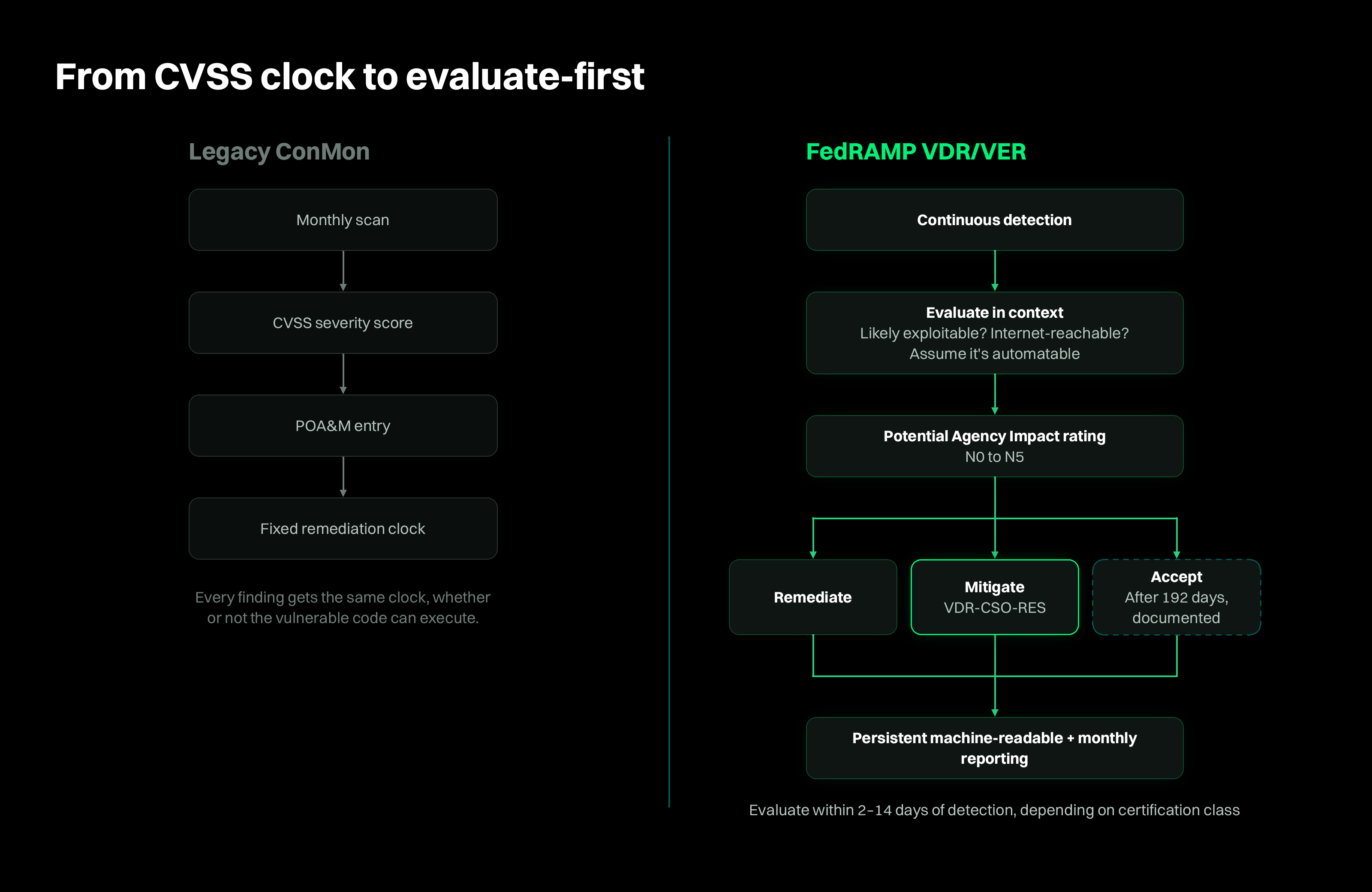
For years, ConMon meant monthly scans, Common Vulnerability Scoring System (CVSS) scores, and fixed remediation windows, whether or not the vulnerable code could ever execute.
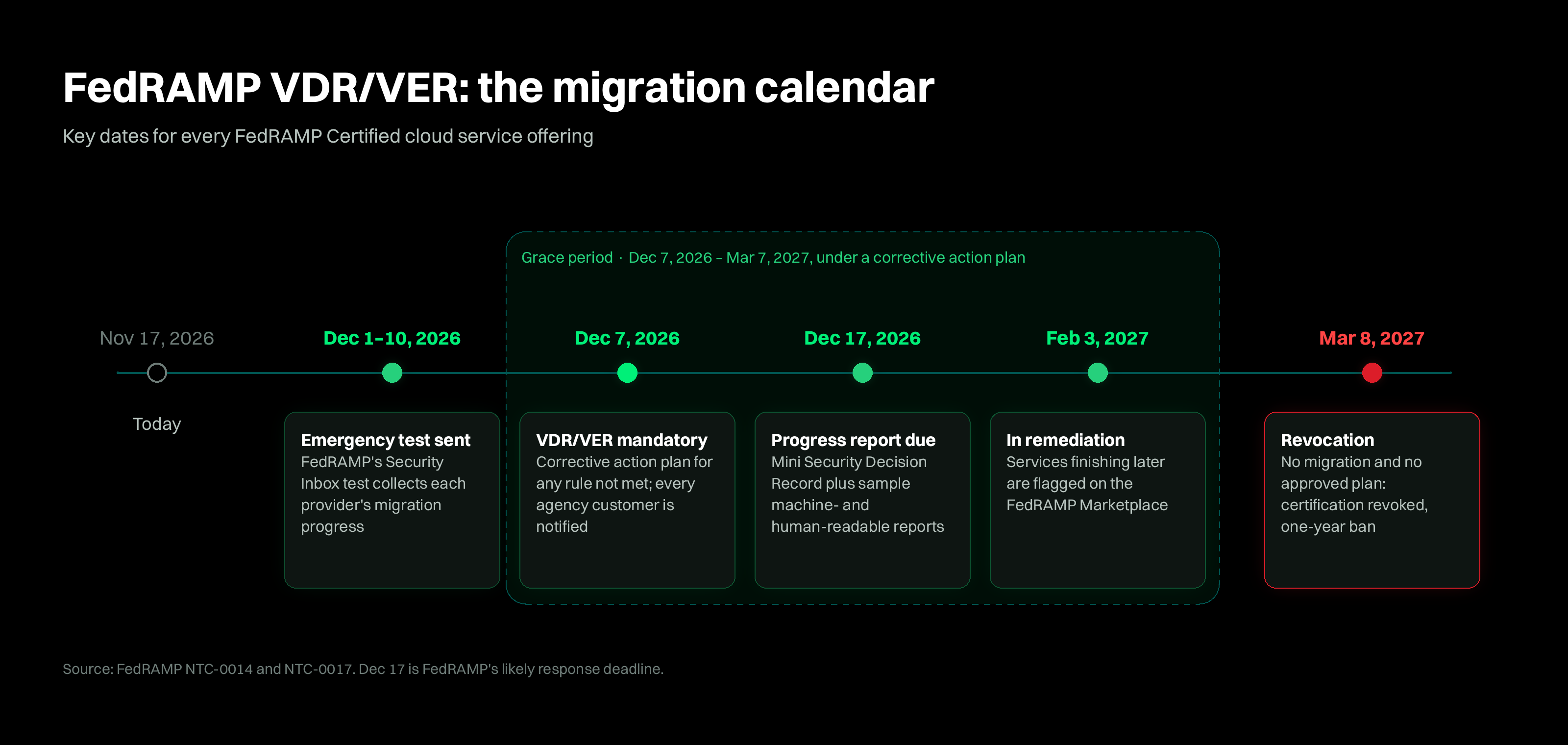
That model is ending. In June, the Cybersecurity and Infrastructure Security Agency issued Binding Operational Directive (BOD) 26-04, which moves federal patching away from uniform deadlines and toward risk based on exposure, Known Exploited Vulnerability (KEV) status, automatability, and impact. FedRAMP responded by pulling mandatory adoption of its new Vulnerability Detection and Response (VDR) and Vulnerability Evaluation and Reporting (VER) rules forward from June 2027 to December 7, 2026.
The headline requirements:
- Evaluate every finding in context. Providers must decide whether each vulnerability is likely exploitable (VER-EVA-ELX) and internet-reachable (VER-EVA-EIR), meaning a payload from the internet could trigger it, even deep in the stack.
- Assume it's automatable. Exploits are treated as automatable unless you have evidence otherwise (VER-EVA-AIA).
- Rate the impact. Each vulnerability gets a Potential Agency Impact rating from N0 to N5 (VER-EVA-EPA).
- Move fast. Evaluation is expected within 2 to 14 days of detection, depending on certification class (VER-TFR-EVU), and KEVs must be remediated on BOD 26-04 timelines (VDR-TFR-KEV).
- Report continuously. Persistent machine-readable reporting and monthly human-readable reports replace the legacy ConMon deliverables of monthly scans and plan of action and milestones (POA&M) entries.
The November 10 notice set the enforcement calendar:
What this means for security operations
The old model rewarded volume: scan, file a plan of action and milestones entry, start the clock. The new model rewards judgment, and judgment has to be documented, defended, and delivered in days rather than months.
Every finding needs a defensible verdict, because the burden of proof has flipped. FedRAMP notes that most scanner findings are not likely exploitable, but it also warns that providers who mark them that way "without careful consideration" will pay for it when one turns out to be the root cause of an incident. Expect assessors to ask how you evaluate, not just how often you scan. A verdict without evidence is a liability.
Mitigation now counts. VDR-CSO-RES lets providers mitigate a vulnerability until it is no longer automatable or internet-reachable, rather than waiting on a full upgrade. That's good news, but only if your team can produce safe mitigations fast and prove they work.
Containers need their own answer. Most vulnerabilities in a container image come from its base image, not the application. Under a 2-to-14-day evaluation window, "we'll rebuild next quarter" stops being a plan.
Reporting becomes a data pipeline. Per-vulnerability records in FedRAMP's JSON schema, monthly human-readable reports, and a 192-day clock on every finding cannot be assembled by hand before each deadline. Your agency customers face the same December 7 date under BOD 26-04, and they'll use your data to decide which findings matter to them.
And many providers are finding their tooling isn't up to it. "A lot of those providers aren't able to meet these new requirements, so they're having to look for new providers," Matt Bruggeman of A-LIGN told Federal News Network.
Critical tools and processes
Whatever vendors you choose, a program that meets VDR/VER needs a few capabilities working together. Here's how they map to the rules:
Two process changes matter as much as the tools: give someone clear ownership of the evaluation step, and reduce inflow. Every vulnerable or malicious package stopped at the door is one you never have to evaluate or report.
How Endor Labs helps
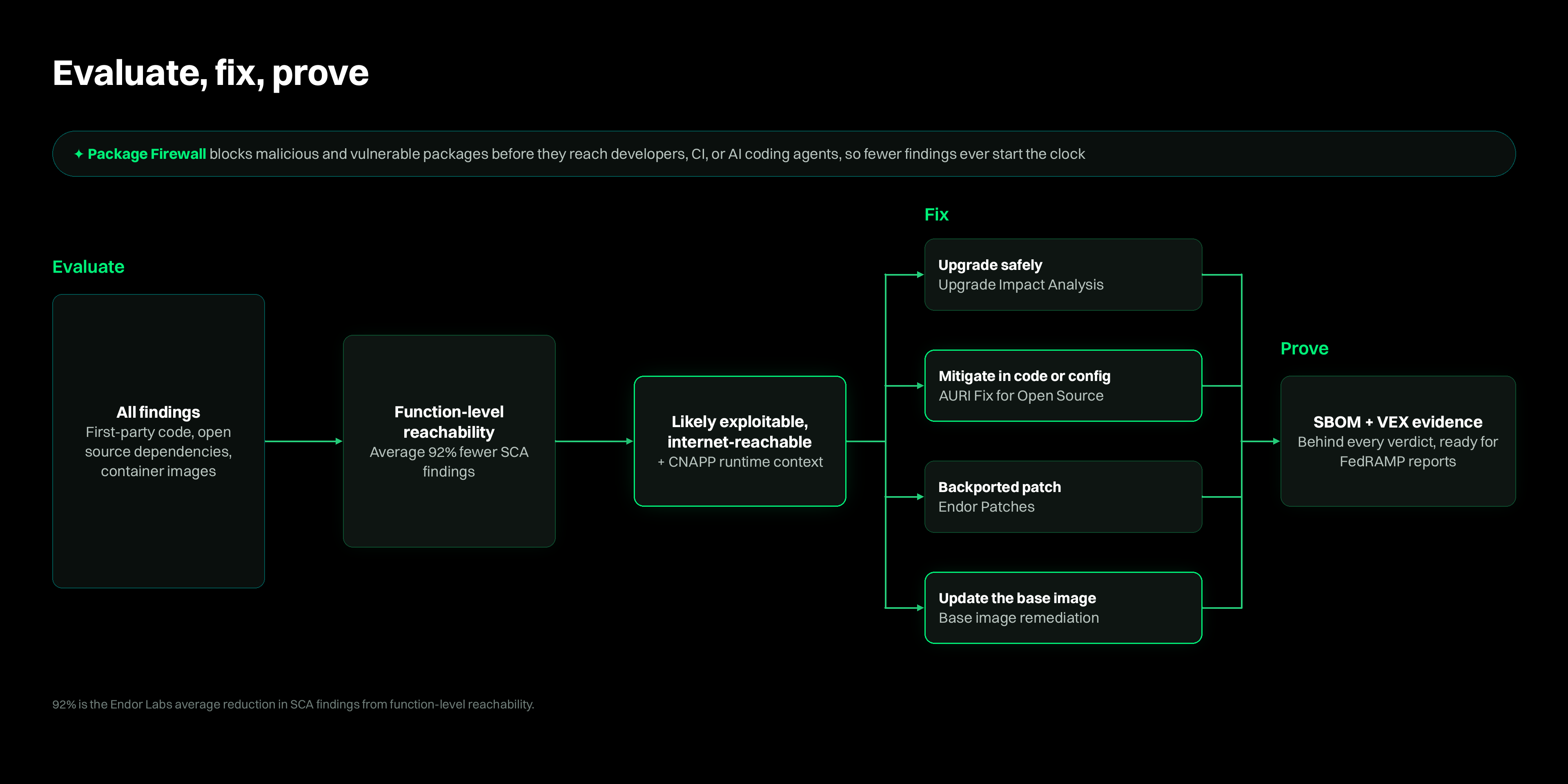
Endor Labs covers the evaluate, fix, and prove loop across first-party code, open-source dependencies, and containers, so the evidence in your report comes from the same analysis that drove the fix.
Evaluate with reachability auditors accept
Function-level reachability identifies which vulnerabilities your application can actually call, cutting software composition analysis (SCA) findings by an average of 92% and container vulnerability noise by up to 90%. FedRAMP third-party assessment organizations (3PAOs), including Fortreum and Schellman, accept this analysis as evidence. When Egnyte pursued FedRAMP, only 9% of its findings proved reachable, and mean time to remediate fell by 70%. CNAPP integrations such as Microsoft Defender for Cloud and Wiz add runtime exposure context for internet-reachability. (We covered evaluation in depth in FedRAMP 2026 vulnerability rules make reachability a requirement.)
Fix open source faster with AURI Fix
Knowing what to fix doesn't help if you can't ship the fix. Our research across 264,643 reachable findings in enterprise codebases found only 10% could be resolved with a straightforward upgrade, but 82% had a remediation option in first-party code.
AURI Fix for Open Source, part of AURI by Endor Labs, evaluates how your application uses a vulnerable dependency, then chooses the least disruptive fix: upgrade, mitigate in code or configuration, patch, or replace. Code mitigations are small (the median pull request in testing was 6 lines) and break the exploit path while the dependency stays put. That maps neatly onto VDR-CSO-RES: close the exposure now, schedule the full upgrade later. Each fix also generates a VEX record explaining why the vulnerability is no longer exploitable.
Fix containers with base image remediation
Base image remediation separates base image findings from application findings, then compares your current base image with a refreshed build, the next version, and the latest version. For each option it shows how many findings are fixed and introduced, by severity and reachability, so you can pick the update that resolves the most risk without surprises.
class='language-bash'>endorctl container scan \
  --namespace=<your-namespace> \
  --image=<image_name:tag> \
  --project-name=<endor_project_name> \
  --base-image-check-updates

endorctl container remediation list-base-image-updates \
  --namespace=<your-namespace> \
  --image=<image_name:tag> \
  --project-name=<endor_project_name>
Upgrade safely, or don't upgrade at all
Upgrade Impact Analysis flags breaking changes before you merge, which matters when 94% of patch and minor upgrades that fix a vulnerability contain at least one potentially breaking change. When an upgrade is off the table, Endor Patches backport the vetted upstream fix to the version you already run.
Prove it, and shrink the inflow
Endor Labs deduplicates findings across SCA and container scans and generates the SBOM and VEX evidence behind every verdict. Upstream, Package Firewall blocks malicious and vulnerable packages before they reach developers, CI pipelines, or AI coding agents.
Evidence over paperwork
FedRAMP's VDR/VER rules replace the CVSS clock with an evaluate-first model: decide what's reachable and exploitable, fix or mitigate it fast, and prove it continuously. The December 7 deadline is fixed, the March 8 consequences are severe, and FedRAMP has been clear that this is "only the first of many migrations."
The program also declared that "yearly paperwork exercises are no longer appropriate or sufficient." Few people who have assembled a ConMon package will mourn them. Replacing paperwork with evidence takes tooling that can keep up.
If you're preparing your migration progress report, see how Endor Labs supports FedRAMP vulnerability evaluation and reporting, or book a demo to walk through your ConMon workflow and try AURI Fix and base image remediation for yourself.
What's next?
When you're ready to take the next step in securing your software supply chain, here are 3 ways Endor Labs can help: