


TL;DR
- Traditional SAST matches code against human-written rules and taint models. It's deterministic and fast on known classes like SQL injection, but it only finds what rule authors anticipated and can't tell what the code is for.
- Products labeled AI SAST differ. LLM triage layers inherit the rule engine's detection limits, and single-file LLM analyzers can't follow data across services. Only reasoning agents built on program analysis change what gets detected.
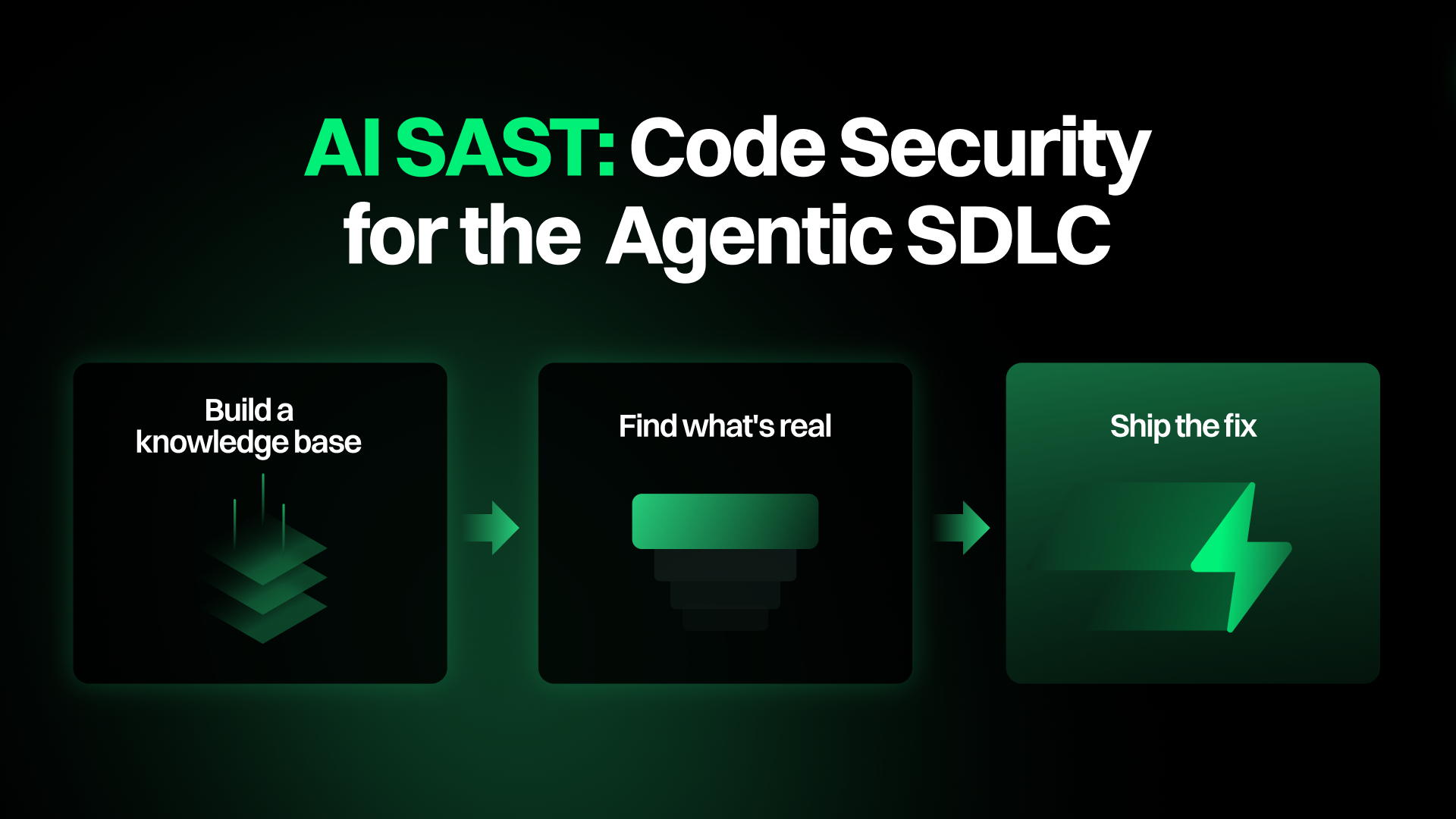
- Endor Labs AI SAST runs detection, triage, and remediation agents on callgraphs and dataflow, so it catches authorization flaws that rules miss and found CVE-2026-55407 in buffa, Anthropic's Rust protobuf library.
- Endor Labs reports up to 92% false positive reduction, with evidence attached to every verdict, while scoping the model to specific paths keeps cost and run-to-run drift contained.
Almost every SAST vendor now puts "AI" somewhere on the product page. Some mean a model that writes friendlier explanations of rule hits. Others mean static analysis that can reason about what your code is supposed to do. Those two products behave very differently once they meet a real codebase, and the label alone won't tell you which one you're buying.
Traditional SAST matches code against human-written rules and taint models. AI SAST, as we use the term here, applies LLM reasoning on top of program analysis to judge what the code is meant to do and where its data goes. If you want the fundamentals first, start with what AI SAST is and how it works. This piece is about how the analysis works. Scanning code that AI assistants wrote is a separate topic, covered in how static analysis handles AI-generated code.
How does traditional SAST find vulnerabilities?
Traditional SAST finds vulnerabilities by matching code against rules that describe known-bad patterns and by tracing untrusted data toward dangerous functions.
Under the hood, a scanner parses source into a syntax tree and usually builds control-flow and data-flow graphs. Taint tracking marks inputs such as request parameters as sources and dangerous calls such as raw SQL execution as sinks. If tainted data reaches a sink without passing through a recognized sanitizer, a rule fires. The OWASP Developer Guide describes these techniques in vendor-neutral terms if you want a reference.
This approach is deterministic: the same code and the same rules produce the same result every time. It's fast on well-understood classes like SQL injection and cross-site scripting. It covers the whole codebase at line level.
The limits come from the same design. A rule only finds what its author anticipated. If your team wraps database access in a custom helper the rule doesn't model, the scanner can miss a real injection. If your team validates input with a function the rule doesn't recognize, the scanner flags safe code. Teams tune out that noise by writing more rules and suppressions, and someone has to maintain all of them. Most of all, a rule has no idea what the code is for. It can tell that a value flows into a query. It can't tell that a user is reading someone else's document. For the longer history, see why rule-based SAST stalled.
How does AI SAST reason about code?
AI SAST reasons about code by giving a language model the program's structure, call paths, and data flow, then asking it the questions a security engineer would ask about one specific path.
In practice, products sold as "AI SAST" fall into three groups:
- An LLM triage or autofix layer on top of rule output. The rule engine still decides what gets found. The model filters or explains those hits and may draft a patch. This can cut noise, but it can't find a bug that no rule flagged.
- An LLM analyzer used where full static modeling doesn't exist yet. Some vendors send code to a model for languages or frameworks their engine doesn't support, sometimes one file at a time. It helps with coverage gaps, but a model that sees one file can't follow data across services, middleware, and helpers.
- Reasoning agents built on a semantic model of the code. Program analysis builds callgraphs and dataflow first. The model reasons over specific paths that analysis surfaces, with the surrounding code as context. This is the only variant that changes what gets detected as well as how findings are triaged.
Endor Labs AI SAST is an example of the third group. It orchestrates specialized agents. Detection agents trace user-controlled data from source to sink across multi-file architectures, including flows that cross 3 to 5 architectural layers. Triage agents classify each finding. Remediation agents propose a fix written for the surrounding code. The system combines rule-based pattern matching, dataflow analysis, and multi-pass LLM reasoning, so the AI works on top of program analysis instead of on top of pattern matching alone.
One real-world result: Endor Labs AI SAST traced untrusted wire data to an unbounded allocation in buffa, Anthropic's Rust protobuf library, uncovering a memory-amplification denial of service tracked as CVE-2026-55407. A tool that only filters rule output can't produce that kind of finding, because no rule existed for it.
For the agent design in more depth, read about AI SAST that thinks like a security engineer.
AI SAST vs traditional SAST: side-by-side comparison
This table compares rule-based SAST with reasoning-based AI SAST built on program analysis. The LLM-triage-only variant sits in between: it inherits the rule engine's detection limits.
Traditional SAST keeps the edge on raw speed and strict determinism for known patterns.
What changes for business logic and authorization flaws?
AI SAST can catch authorization and business logic flaws because it checks whether the code does what it should, while rule-based SAST only checks whether code matches a known-bad shape.
Broken access control is the number 1 risk in the OWASP Top 10, and OWASP found some form of it in 100% of the applications it tested. Insecure design and business logic flaws do similar damage and share the same problem for scanners. These bugs depend on your application's authorization rules, not on a fixed pattern.
Here's a small Flask example with two handlers for the same resource:
@app.put("/documents/<int:document_id>")
@login_required
def update_document(document_id):
    document = Document.query.get_or_404(document_id)
    if document.account_id != current_user.account_id:
        abort(403)
    document.update(request.json)
    return jsonify(document.to_dict())


@app.get("/documents/<int:document_id>")
@login_required
def get_document(document_id):
    document = Document.query.get_or_404(document_id)
    return jsonify(document.to_dict())
The get_document handler is an insecure direct object reference (IDOR). Any logged-in user can read any document by changing the ID in the URL.
A rule engine walks the taint path and sees nothing wrong. document_id comes from the URL, which makes it a source. It flows into an ORM lookup, which is parameterized, so there's no SQL injection. The response is JSON, so there's no cross-site scripting. No tainted sink, no match. The @login_required decorator might even look like a security control to a simple rule.
A reasoning pass asks different questions about the same path:
- A user-controlled ID selects a record that belongs to an account. Is this a tenant-scoped resource? The account_id field says yes.
- Does anything on this path compare the record's owner with the caller? @login_required handles authentication, not authorization. No ownership check exists.
- How do sibling handlers treat the same resource? update_document compares document.account_id with current_user.account_id and returns 403 on mismatch. The read path skips a check the write path performs.
- Verdict: true positive, broken access control, with the path and the missing check as evidence.
No single rule captures step 3. A reasoning system can, because it compares this code with the code next to it.
What changes for false positives and triage?
AI SAST reduces false positives by checking whether each finding is exploitable and attaching the evidence behind every verdict, so reviewers verify a conclusion instead of starting an investigation.
Compare two outputs for a SQL injection candidate. A raw rule hit looks like this:
[HIGH] sql-injection-string-concat
reports.py:42  cursor.execute(f"SELECT * FROM reports WHERE id = {report_id}")
That's a line number and a pattern name. Now someone has to open the file, trace report_id back through the callers, and decide whether it's dangerous.
A reasoned finding for the same line carries the work already done:
Finding: SQL query built with f-string
Path:    GET /reports/<id> (routes.py:18)
         -> load_report(report_id) (reports.py:37)
         -> report_id = int(raw_id) (reports.py:38)
         -> cursor.execute(...) (reports.py:42)
Verdict: False positive
Reasoning: report_id is cast to int at reports.py:38 before reaching
           the query. A non-integer value raises ValueError before
           execution. The string formatting is poor style but not
           exploitable on this path.
Suggested change: Use a parameterized query for consistency.
A reviewer can check that verdict in under a minute by opening line 38. Attaching evidence makes the tool's classification auditable instead of a black box.
Endor Labs AI SAST triage agents classify each finding as true positive, false positive, or unknown. Context also catches cases that pattern matching gets wrong in the other direction. Use of SHA-1 inside ASN.1 DER encoding is a legitimate use, not a weak-hash vulnerability, and a context-aware triage pass can tell the difference. Endor Labs reports up to 92% false positive reduction for AI SAST.
"Unknown" deserves a word of defense. A tool that can't confirm exploitability and says so is giving you an honest output. The alternative is a confident guess, and confident guesses are how false positives and false negatives both happen. Teams can then use policy to decide what happens next, for example routing unknowns to the owning team, or blocking a pull request only on high-confidence true positives.
What changes for remediation?
AI SAST changes remediation by proposing a fix written for your code instead of a generic advisory tied to a rule.
A traditional finding for SQL injection usually comes with guidance like "use parameterized queries." That's correct and close to useless at 4 p.m. on a Thursday. The developer still has to figure out which query builder the service uses, whether a repository helper already exists, and what the change does to callers. Researching a real SAST finding this way can take 4 or more hours.
A context-aware fix starts from what's already in the codebase. For the document example above, the proposed change would mirror the existing pattern from update_document, or scope the query directly:
document = Document.query.filter_by(
    id=document_id, account_id=current_user.account_id
).first_or_404()
That fix uses the same ORM, the same 404 behavior, and the same ownership model the team already wrote. A developer reviews a diff instead of writing one from scratch.
Where the fix shows up matters as much as what it says. Endor Labs AI Security Review runs the AI SAST engine on every pull request, confirms which vulnerabilities are exploitable, and posts a context-aware fix in the PR. The developer sees the issue while the change is still fresh, in the tool they already use. Security becomes help during code review rather than a ticket that lands weeks later.
What are the speed, consistency, and cost trade-offs?
AI SAST is slower and more expensive per scan than rule matching, and LLM output can vary between runs, so the design has to contain all of that.
Inference takes longer than a regex. Every token costs money. Language models are nondeterministic: send the same prompt twice and you can get two different answers. Pointing a model at an entire repository multiplies all of these problems. The bill grows with the codebase, and results drift from scan to scan, which makes it hard to trust a finding that appears on Tuesday and vanishes on Wednesday.
The answer is architectural. Deterministic program analysis does the work it's good at: building callgraphs, tracing dataflow, and finding candidate source-to-sink paths. The model only reasons about those specific paths, with the relevant context attached. That keeps prompts small and pins the model's inputs to facts the analysis already established. The same code produces the same paths, so the questions the model sees stay stable between runs.
Endor Labs AI SAST works this way. It runs on Endor Labs' Code API, a semantic model of the application with callgraphs and dataflow, instead of sending whole codebases to an LLM. Code API supports C, C#, Go, Java, JavaScript, and Kotlin. AI SAST also runs on other languages, but scans in Code API languages are faster and cheaper because the model receives precise, pre-computed context.
The savings are measurable. In Endor Labs' token economics benchmark, an agent using Endor Labs tools did identical security work at 12x lower token cost (6.6M tokens versus 79.5M) and 2.8x faster (133 minutes versus 370) than the same model reasoning alone, across 442 security prompts in 12 projects and 6 languages.
Nobody has fully solved nondeterminism, and you should be wary of anyone who says otherwise. What you can ask is how much of the pipeline is deterministic, what the model is allowed to decide, and whether verdicts come with evidence you can check.
Do you still need rule-based SAST?
Yes, you still need rule-based analysis, but as one layer inside a reasoning system rather than as the whole system.
Endor Labs AI SAST keeps rule-based pattern matching as one input next to dataflow analysis and LLM reasoning.
Rules still fit well in a few places:
- Known vulnerability patterns where a match is almost always a real problem, such as hardcoded credentials or disabled TLS verification.
- Organization-specific policies, like banning a deprecated internal crypto helper.
- Fast, deterministic checks in the IDE, where developers need feedback in milliseconds.
So the decision in front of you is architectural. Ask where reasoning sits relative to your rules, and whether it can see past them.
How to evaluate an AI SAST tool
The most reliable way to evaluate an AI SAST tool is to run it against code where you already know the real vulnerabilities and count what it finds and misses.
Here's a test you can run in a few weeks:
- Build ground truth. Pick 2 to 4 of your own repositories with vulnerabilities you've already confirmed, through past pentests, bug bounty reports, or fixed incidents. Include at least one authorization bug.
- Run every candidate tool on the same commits. Use default configurations first, then tuned ones, and record both.
- Count four numbers. True findings, missed findings, false positives, and time to triage each finding.
- Measure fix acceptance. Of the fixes each tool proposes, how many would your engineers merge with little or no editing?
- Run it twice. Scan the same commit again and compare. Large differences tell you how much the model is deciding on its own.
Then ask each vendor:
- Which of the three variants is this: a triage layer on rules, an LLM fallback, or reasoning on a semantic code model?
- What evidence comes with each finding, and can a reviewer verify the verdict from it?
- How are cost and repeatability controlled at enterprise scale?
- What happens with code the tool can't model?
Endor Labs ran its own benchmark this way. Across 8 real-world projects in Java, Python, JavaScript, TypeScript, C#, and Go, the Endor Labs security research team established ground truth first. AI SAST then found 192 real vulnerabilities: 2.6x what Claude Opus 4.7 found and 3.5x what Codex (GPT-5.5) found on the same projects. 63 of those vulnerabilities were caught by no other tool in the test, and AI SAST covered 64 of 106 CWE types, against 36 for the next tool. The full benchmark has the methodology. Hold us to the same standard you'd hold any vendor.
A separate evaluation covered embedded C. On four real-world embedded C projects in one customer codebase, AI SAST caught 96 of 102 known vulnerabilities. That's 48x as many as the next-best buildless, pattern-based SAST tool in the comparison. The full details are in AI SAST results on embedded C.
If you want to run the ground-truth test on your own code, start with Endor Labs AI SAST. For a deeper technical read on combining program analysis with agentic reasoning, see the AI SAST whitepaper.
FAQs
Does AI SAST replace DAST or SCA?
No, AI SAST doesn't replace DAST or SCA, because each one looks at a different part of your risk. AI SAST analyzes your first-party source code. SCA covers open-source dependencies and the vulnerabilities inside them. DAST tests a running application from the outside. Reasoning makes static analysis better at logic and authorization bugs, but it doesn't see a vulnerable transitive dependency or a misconfigured production server.
Is AI SAST the same as using ChatGPT to review code?
No, pasting code into a general-purpose chatbot isn't AI SAST in the sense this article describes. A chatbot sees only what you paste, usually a file or a function. It has no callgraph and no dataflow across services, and it doesn't know about the sibling handler that does the ownership check. It may give a different answer each time you ask. Reasoning-based AI SAST grounds the model in program analysis of the whole application, scopes it to specific paths, and attaches evidence a reviewer can verify.
What is the difference between AI SAST and traditional SAST?
Traditional SAST matches code against human-written rules and taint models, while AI SAST applies LLM reasoning on top of program analysis to judge what the code is meant to do and where its data goes. A rule can tell that a value flows into a query, but it has no idea what the code is for, so it misses flaws like broken access control. Reasoning-based AI SAST, such as Endor Labs AI SAST, builds callgraphs and dataflow first and then reasons over specific paths with the surrounding code as context. Since almost every SAST vendor now uses the "AI" label, check whether the model changes what gets detected or only writes friendlier explanations of rule hits.
Can AI SAST find vulnerabilities that no rule was written for?
Yes, reasoning-based AI SAST can, because detection doesn't depend on a prewritten rule. Endor Labs AI SAST traced untrusted wire data to an unbounded allocation in buffa, Anthropic's Rust protobuf library, uncovering CVE-2026-55407. A tool that only filters rule output couldn't produce that finding, because no rule existed for it. Endor Labs AI SAST detection agents trace user-controlled data from source to sink across multi-file architectures, including flows that cross 3 to 5 architectural layers. Separate agents then classify each finding and propose a fix written for the surrounding code.
What's next?
When you're ready to take the next step in securing your software supply chain, here are 3 ways Endor Labs can help: