


TL;DR
Here's the shortlist, ranked by where each tool's AI does its work and how much of your code that AI can see:
- Endor Labs AI SAST
- Checkmarx One
- Semgrep
- GitHub Advanced Security with CodeQL
- Cycode
- Aikido Security
- Veracode
- ZeroPath
- Qwiet AI
This ranking is for teams that ship more than 1,000 pull requests across hundreds of repositories, with AI coding agents writing a growing share of that code. Many of those teams already run a SAST tool. They also have a backlog of findings that developers learned to ignore a long time ago. AI SAST promises to fix that by finding more real bugs and fewer fake ones, but every vendor now says "AI." The useful question is what the AI does inside each product. If you're new to the category, start with what AI SAST is and how it works.
This list covers AI-powered SAST only. If you want a broader view of static analysis, see our comparison of SAST tools in 2027. For platforms that secure AI-era applications more broadly, see our guide to gen AI AppSec tools.
What makes a tool AI SAST?
A tool counts as AI SAST when AI takes part in the static analysis itself, at some point between reading the code and handing a developer a fix. Where that AI sits matters. In practice, you'll see four placements:
- AI in detection. Agents reason over code to find vulnerabilities, often on top of dataflow analysis. This placement can surface new classes of bugs.
- AI as a triage layer. An LLM reviews findings from a rule engine and filters or ranks them. Noise drops, but the tool still only finds what the rules describe.
- AI for autofix. The scanner finds issues the traditional way, and an LLM writes the patch.
- AI PR reviewers. A model reads the diff and comments on security issues, usually with limited context outside the changed files.
Readers mix these up all the time, and vendors don't always help. A triage layer can make a rule-based scanner far more pleasant to use. It can't make that scanner find a missing authorization check that no rule describes.
Coverage is where the placement shows. Rule-based SAST handles known patterns like SQL injection and cross-site scripting well. It struggles with broken access control, insecure design, and business logic flaws, because those bugs depend on what the code is supposed to do. A pattern can say "user input reaches a query." It has a hard time saying "this endpoint returns another tenant's records." How we ranked these AI SAST tools
We scored each tool on five criteria. They reflect what AppSec leads and developers ask about during a proof of concept.
- Where the AI works. Does it detect, triage, fix, or only explain findings a rule engine already produced? Tools with AI in detection ranked higher because they can find bug classes rules miss.
- Coverage of hard flaw classes. Can it catch broken access control, IDOR, insecure design, and business logic flaws, or mostly injection patterns?
- Context depth. Does the AI reason over only the changed file, or across the whole repository, its open-source dependencies, and your organization's conventions, such as internal auth helpers? Access control and logic bugs live in that wider context.
- Evidence and fix quality. Does each finding come with a data flow, a call path, and an exploitability verdict a human can check? Does the fix compile and fit the codebase?
- Workflow fit. Does it run where developers work: the IDE, the pull request, CI, and AI coding agents?
AI SAST tools compared at a glance
1. Endor Labs AI SAST
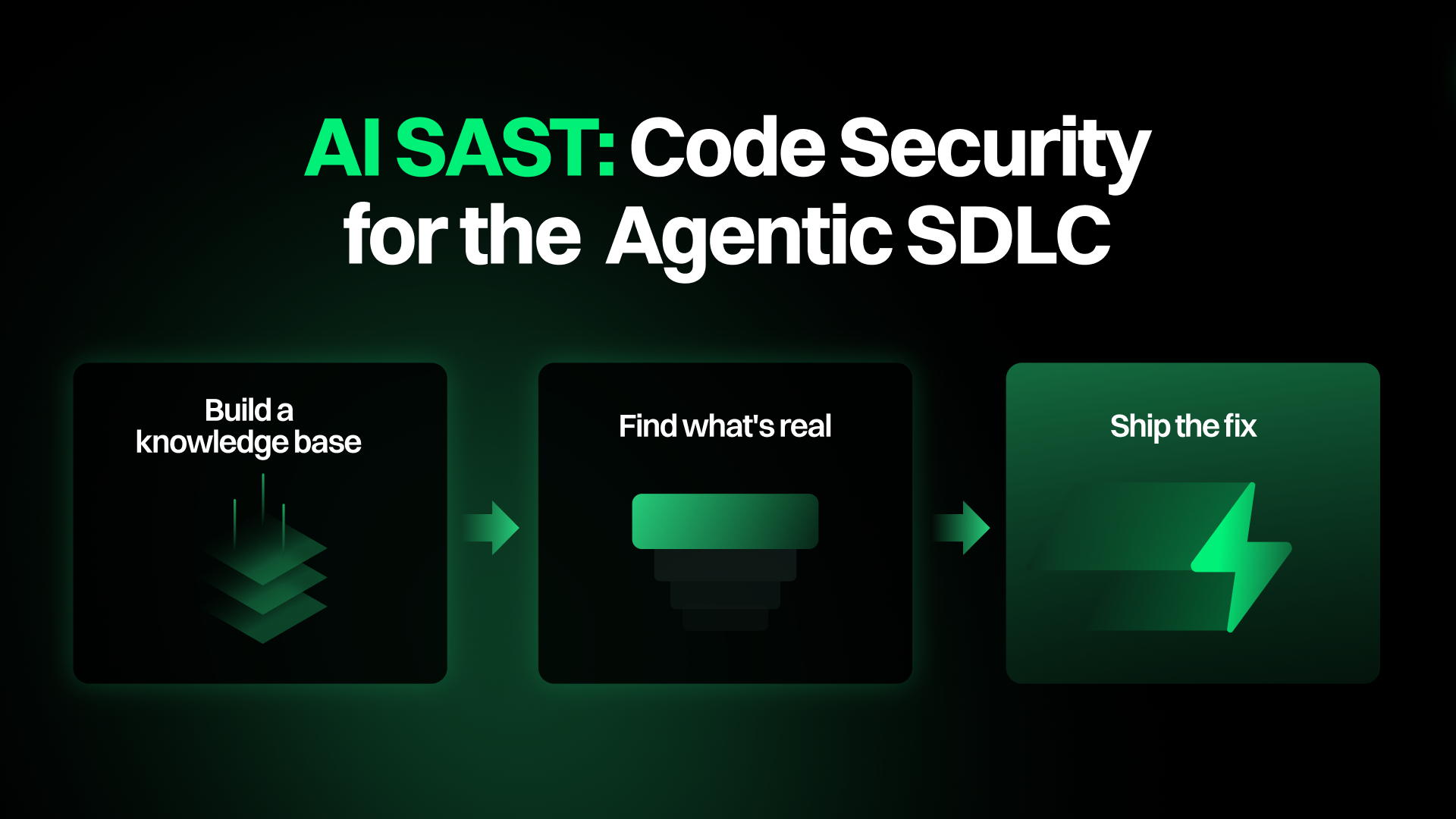
Endor Labs AI SAST puts AI inside detection, then keeps going through triage and remediation. It orchestrates multiple specialized AI agents that analyze code the way a security engineer would. Rule-based pattern matching and dataflow tracing do the deterministic groundwork. Multi-pass LLM reasoning sits on top.
The pipeline splits the work across agents:
- Detection agents trace user-controlled data from source to sink across multi-file architectures, following it through 3 to 5 architectural layers.
- Triage agents classify every finding as true positive, false positive, or unknown, and write down the reasoning so your team can audit it.
- Remediation agents propose a context-aware fix alongside every confirmed vulnerability.
Under the hood, AI SAST runs on Endor Labs' Code API, a semantic model of your application with call graphs and dataflow. It doesn't dump an entire codebase into an LLM. That design keeps costs contained at enterprise scale. Code API support covers C, C#, Go, Java, JavaScript, and Kotlin, and those languages get faster, cheaper scans. AI SAST runs on other languages as well.
A worked example: access control across files
Here's how that pipeline handles a typical IDOR. A route handler in routes/projects.js reads req.params.id and passes it to projectService.getProject(id) in a separate service file. That service calls a repository function that runs SELECT * FROM projects WHERE id = ?. Nothing in that chain checks whether the project belongs to the caller's organization. Elsewhere in the codebase, every comparable route calls an internal helper, requireOrgAccess(req.user, resource).
A pattern-based rule sees a parameterized query and moves on, since there's no injection. The detection agent follows the ID from the route through the service to the query and flags a missing ownership check. The triage agent then looks upstream for middleware that might enforce access, finds none, and marks the finding as a true positive, with its reasoning attached. The remediation agent proposes a fix that calls requireOrgAccess before the lookup, using your existing helper instead of inventing a new one.
Full-context reasoning
Endor Labs builds a patented code context graph that models application behavior at the line level. Full-stack reachability connects that graph across first-party code, open-source dependencies, and container images, so the AI reasons about how your code calls the libraries it pulls in. AI SAST also learns what matters to your organization, such as internal auth helpers, accepted crypto patterns, and team-specific risk priorities. You can tune it with custom prompts and feedback. For the mechanics, read how AI SAST learns your organization's context.
Context also cuts noise. AI SAST recognizes SHA-1 inside ASN.1 DER encoding as a legitimate use instead of a weak-hash vulnerability. A pattern match can't tell those two cases apart.
Proof you can check
- Up to 92% false positive reduction for AI SAST.
- Coverage of the full OWASP Top 10 for 2025, including categories that require semantic understanding of authorization flows, such as broken access control and insecure design.
- A real-world zero-day: Endor Labs AI SAST traced untrusted wire data to an unbounded allocation in buffa, Anthropic's Rust protobuf library, uncovering a memory-amplification denial of service tracked as CVE-2026-55407.
- Developers who used to spend 4+ hours researching a single SAST finding get the data flow and a proposed fix in minutes.
The benchmark against frontier models gets its own section below.
C, memory safety, and complex builds
Teams shipping embedded, connected-product, or regulated software in C/C++ face a separate problem. Many SAST tools need a full build to analyze C, which is painful in complex build environments such as Bazel. Buildless tools that rely on patterns miss most memory-safety bugs. Endor Labs AI SAST runs buildless, in the IDE and on the PR. On four real-world embedded C projects in one customer's codebase, AI SAST caught 96 of 102 known vulnerabilities. That's 48x as many as the next-best buildless, pattern-based SAST tool in the same comparison. This result is separate from the multi-language benchmark below; the details are in why Endor Labs AI SAST for C finds what other tools miss.
Where it runs
AI SAST runs in the IDE and in CI/CD. AI Security Review applies the same engine to every pull request on GitHub, GitLab, and Bitbucket. One PR scan covers the code, the dependencies the change touched, and any secrets it introduced. Results land as PR comments and feed Endor Labs' policy engine. OPA-based policies let you suppress known false positives, route findings by team, and hold a merge only on high-confidence findings. After rollout, fewer than 10% of PRs need human security review.
For AI coding agents, AURI by Endor Labs is a security harness for agentic software development. AURI brings the same analysis to agents through Hooks, Skills, MCP, a CLI, and an API, so agents and developers write secure code from the start instead of waiting for a scan after the build.
Choose Endor Labs AI SAST if you need to catch access control and logic flaws without adding triage work, or if you ship C code that other tools can't analyze without a build.
2. Checkmarx One
Checkmarx One is the enterprise incumbent, and its AI arrives through the Checkmarx One Assist agents. Developer Assist works in the IDE, Policy Assist helps apply organizational policy, and Insights Assist covers reporting. Together they handle triage, remediation, and IDE scanning. Checkmarx also supports MCP integration with AI coding assistants such as Claude Code and Cursor.
The AI sits mostly on top of the scanner, as a triage and remediation layer. Checkmarx's own published guidance says rule and policy tuning is needed to reduce noise, so plan for someone to own that work.
Choose Checkmarx One if you run a large program with centralized governance and already have staff to tune it.
3. Semgrep
Semgrep starts from rules. Its engine supports dataflow and taint tracking, and the rule syntax is readable enough that security engineers write their own. On top of that, Semgrep offers AI analysis that the company says finds IDOR and business logic flaws, and that learns from your triage decisions over time.
The tradeoff is ownership. Custom rules are powerful, but they need someone to write, test, and retire them as the codebase changes. If nobody owns the rules, coverage drifts.
Opengrep, the open-source fork of Semgrep Community Edition, gives teams a free starting point for the rule engine.
Choose Semgrep if your team wants fine-grained control over detection logic and has the people to maintain it.
4. GitHub Advanced Security with CodeQL
GitHub's option is the native one. CodeQL builds a semantic database of your repository and runs queries against it, and Copilot Autofix proposes fixes for the alerts. GitHub now sells this capability as GitHub Code Security.
CodeQL is free on public repositories, which makes it the default for many open-source maintainers. Writing and tuning custom queries takes real skill, though, so teams get the most from it when they have security engineers who know the query language.
Choose GitHub Advanced Security if your organization is standardized on GitHub and has engineers who can write CodeQL.
5 to 9: Cycode, Aikido Security, Veracode, ZeroPath, and Qwiet AI
These five each fit a specific situation.
5. Cycode
Cycode combines deterministic SAST with AI-assisted SAST and agentic code scanning. Its AI also assesses exploitability, which helps rank findings. Choose it if you want a deterministic baseline with an AI review layer in the same product.
6. Aikido Security
Aikido Security is a broad platform covering code, cloud, and runtime. On the code side, it offers AI triage, AutoFix, and Deep PR Review. Choose it if you're a smaller or mid-sized team trying to consolidate several security tools into one.
7. Veracode
Veracode pairs its SAST with Veracode Fix, which generates fixes with AI, and with policy reporting for audits. The AI sits at the fix stage. Choose it if your program is driven by compliance and reporting requirements.
8. ZeroPath
ZeroPath is AI-augmented SAST that uses machine learning to cut false positives. Choose it if noise is your main complaint about your current scanner.
9. Qwiet AI
Qwiet AI, now part of Harness, filters findings by reachability and exploitability and offers AI Autofix. Choose it if you already run on Harness and want SAST in the same ecosystem.
Can a frontier model replace an AI SAST tool?
No. In Endor Labs' benchmark, AI SAST found 2.6x as many real vulnerabilities as Claude Opus 4.7 and 3.5x as many as Codex (GPT-5.5), both prompted to find vulnerabilities directly.
The benchmark covered 8 real-world projects in Java, Python, JavaScript, TypeScript, C#, and Go, with ground truth established by the Endor Labs security research team. Endor Labs AI SAST found 192 real vulnerabilities across those projects. 63 of them were caught by no other tool in the test, and AI SAST covered 64 of the 106 CWE types in the benchmark, against 36 for the next tool. You can read the full benchmark methodology and results, including which tools caught which bugs.
The frontier models weren't noisy. They were precise but limited: they rarely raised a false alarm, and they missed most of the real vulnerabilities. On a large enterprise Java codebase, the share of security-relevant code the models actually examined dropped below 10%.
The gap comes from architecture. A frontier model reading files sees whatever fits in its context window. It misses flows that cross many files, and it can give different answers on two runs of the same code. Deterministic program analysis gives the system a repeatable source-to-sink trace first. LLM reasoning then works on that trace to decide whether the path is exploitable and what the fix should look like. The model reasons about evidence instead of guessing at structure, and the cost stays predictable because you're not shipping the whole repository to an LLM on every scan.
Pointing Claude or GPT at a repo can still teach you something during exploration. It just isn't a repeatable control you can run on every PR. Whatever benchmark you read, including ours, check who ran it, how they decided what counts as a real vulnerability, and which tools they included.
Are there free or open-source AI SAST tools?
Free options exist for the static analysis base, but the AI layers are usually paid.
These are the main free starting points:
- Semgrep Community Edition, a rule-based engine you run yourself.
- Opengrep, the open-source fork of Semgrep Community Edition.
- CodeQL on public GitHub repositories.
- SonarQube Community, a self-hosted code quality and security scanner.
What you give up is the part this list ranks. Most vendors keep cross-file analysis and AI triage or autofix in paid tiers. A free tool will find injection patterns and some taint flows. It won't triage its own findings or reason about whether an endpoint enforces authorization. For an open-source project or a small team, that's a sensible starting point. For a team shipping thousands of PRs, the triage hours tend to cost more than the license.
How to test an AI SAST tool on your own code
Run every tool on your own pull requests before you buy, including the one at the top of this list. Recent PRs from your real code tell you more than any demo app, and adding ground truth turns the test into a measurement.
- Pick 10 to 20 recent PRs that touched authentication, billing, webhooks, file handling, or agent permissions. These areas produce the access control and logic bugs that separate AI SAST tools.
- Build your ground truth. Use vulnerabilities you've already fixed by checking out the commit before the fix, or seed a few known issues in a branch.
- Run each tool on the same PRs, with the same configuration a developer would see.
- Record true positives, missed findings, and false positives for each tool.
- Check the evidence. Each finding should show the data flow or call path that makes it exploitable.
- Try the fixes. A proposed fix should compile, pass your tests, and use your existing helpers.
- Have a security engineer review a sample of triage verdicts. If the tool marks something as a false positive, the reasoning should hold up.
At the end, you'll have a per-tool table of hits, misses, and noise on your code. That beats any vendor list, including this one. If you'd like to see what an AI SAST finding with data flow and a proposed fix looks like before you start, take the AI SAST product tour.
FAQs
Does AI SAST replace traditional SAST?
AI SAST replaces the pattern-only approach, but it keeps the deterministic analysis underneath. Rule-based matching and dataflow tracing still do the groundwork in the stronger tools. The AI adds coverage for logic and access control flaws and filters noise before a developer sees it. Teams usually move off a legacy scanner once AI SAST covers the same languages and policies.
What's the difference between AI SAST and an AI code review tool?
AI SAST runs program analysis across the codebase, while most AI code review tools read the diff and comment on it. A code reviewer is useful for style and obvious bugs. It usually lacks the cross-file dataflow and dependency context needed to confirm that a vulnerability is exploitable. Some AI SAST products, such as Endor Labs AI Security Review, run on each PR but keep the full-codebase analysis behind the comments.
When should AI SAST run: in the IDE, on the PR, or in CI?
AI SAST should run in all three places, with each one doing a different job. The IDE and AI coding agents catch issues while code is being written, when fixes cost the least. The PR is where findings get a reviewer's attention and a proposed fix. CI gives you a full-repository view and a record for audits.
How is AI SAST different from gen AI AppSec tools?
AI SAST uses AI to analyze your code for vulnerabilities, while gen AI AppSec tools cover the wider set of risks that come with building on AI. That wider set includes AI models in your supply chain, AI coding agent behavior, and AI-specific threats. AI SAST is one part of that picture, focused on the code itself.
What's next?
When you're ready to take the next step in securing your software supply chain, here are 3 ways Endor Labs can help: