AI SAST

Code analysis that reasons like a security engineer
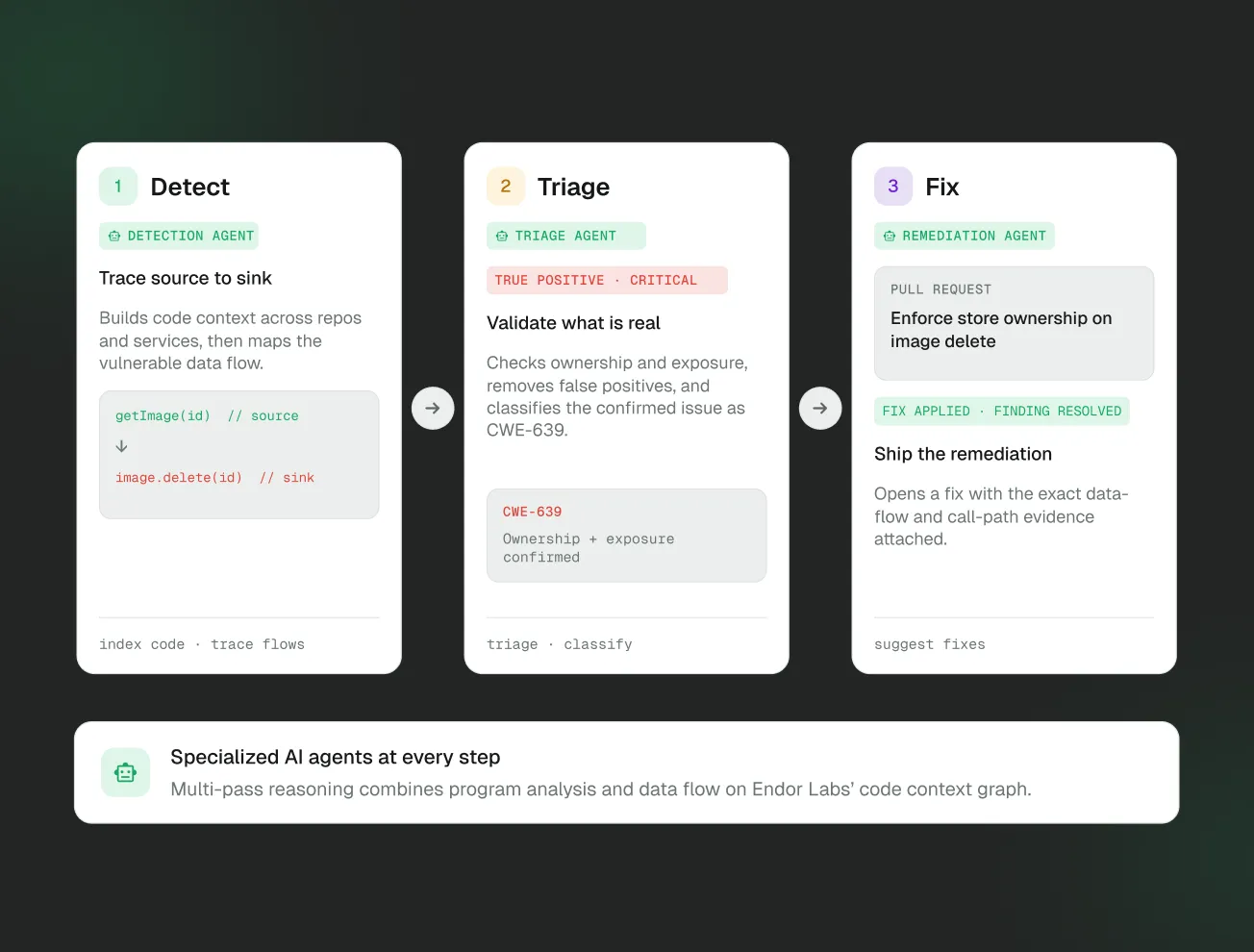
AI SAST orchestrates multiple agents to read, trace, and reason about your code. Because it understands how your application behaves, it finds the flaws other tools miss: broken access control, IDOR, and auth bypass. In our benchmarks, that's 3x the findings of frontier models and 2x rule-based SAST.
Loved by security teams, painless for developers at:

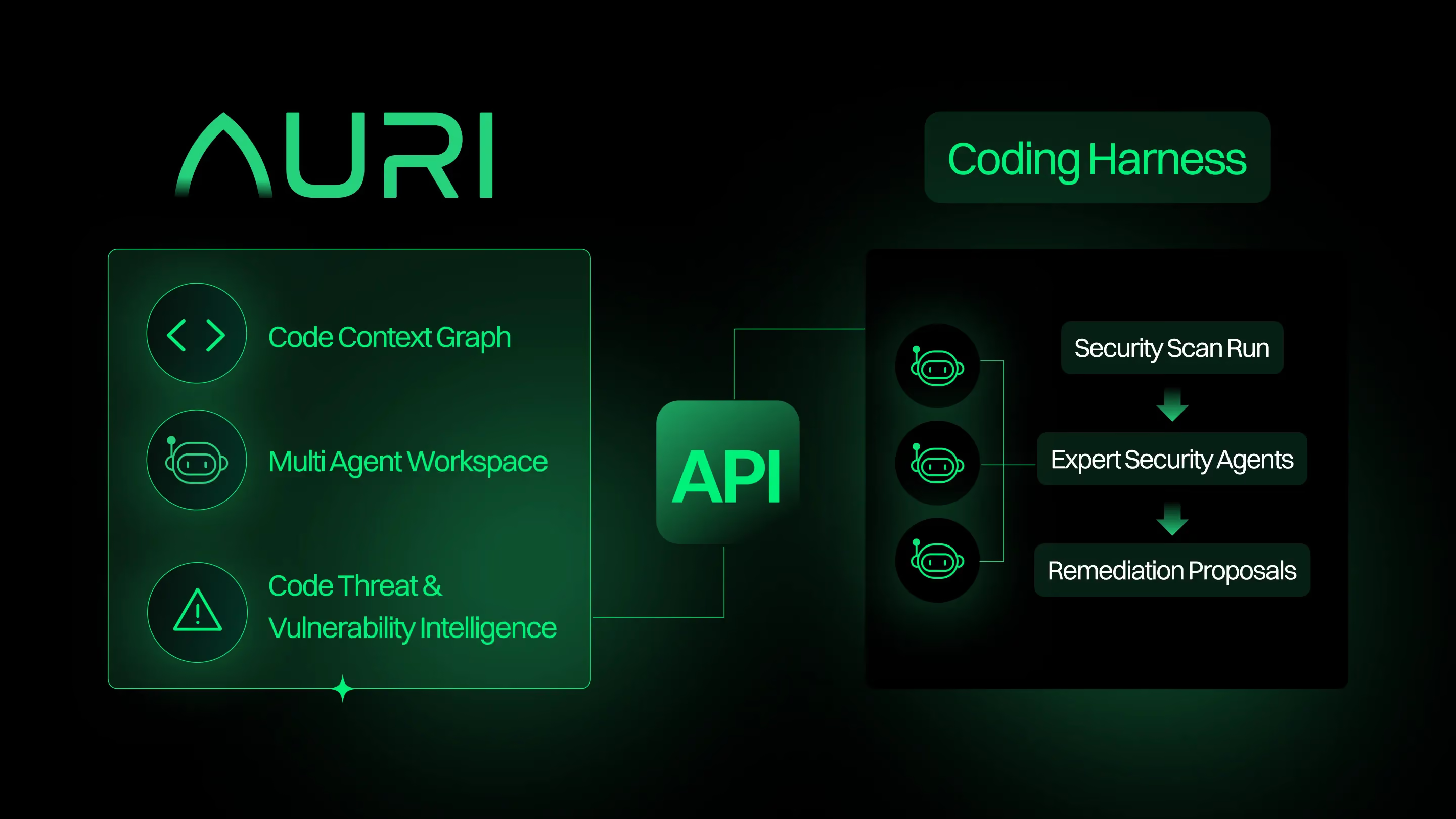
How AI SAST works

Stop drowning in false positives and manual triage
Legacy SAST flags 68-78% false positives on average, and security engineers spend 15-30 minutes triaging each one. At 1M+ alerts a year, the math never works. AI SAST triages every finding automatically, so only real, high-confidence issues reach you or a developer.
Catch the access control and business logic flaws others miss
Rule-based SAST cannot detect IDOR, insecure design, or authorization flaws, yet broken access control showed up in 100% of applications OWASP tested. AI SAST traces user-controlled data across architectural layers to surface the categories pattern matching can't see.
Rebuild trust with engineering by shipping fixes devs can act on
Real vulnerabilities take developers 4+ hours to research and fix, and findings without evidence erode trust. AI SAST delivers a context-aware remediation and the evidence behind it with every confirmed vulnerability, so developers can act quickly instead of researching from scratch.
“Software analysis is hard, and there's only one company [Endor Labs] that's doing it correctly.”
Paul Padilla

Head of Software and Infrastructure Security, Mysten Labs

Only real issues reach your team
Specialized AI agents classify every finding as true positive, false positive, or unknown, with a written explanation your team can audit and learn from.
Cut up to 95% of false positives before they reach you or a developer.
Get an auditable, written explanation for every classification.
Decide what blocks a PR. OPA policies suppress noise, gate only on high-confidence findings, or route by team.
Learn more
Catch the critical flaws traditional SAST misses
Trace user-controlled data from source to sink across multi-file architectures to catch flaws pattern matching can't see.
Find IDOR, broken access control, and insecure design that legacy SAST misses.
Catch flaws that span code: data traced across multiple architectural layers, multi-file and multi-function.
Surface fail-open authentication and missing validation at trust boundaries, no new rules to write.
Learn more
Give developers a fix they can ship
Every confirmed vulnerability ships with a specific, codebase-aware remediation and the evidence behind it.
Ship the fix with the finding: a context-aware remediation alongside every confirmed vulnerability.
Cut the hours developers spend researching a single finding down to minutes.
Plug into existing CI/CD pipelines, Endor Labs' policy engine, or AURI Agent Hub for automated remediation.
Learn more
Flowchart showing integration paths from GitHub, GitLab, and PHP to Slack and Microsoft platforms, with a C# icon connected to Slack.

Your Tools, Your Languages
All Secured

Learn how Endor Labs fits into your ecosystem.
Flow diagram connecting software development tools and platforms including .NET, JetBrains, GitHub, Google, and Vercel.

FAQs

How is AI SAST different from rule-based SAST?

Rule-based SAST matches patterns and can't tell whether user-controlled data actually reaches a vulnerable sink. AI SAST combines pattern matching, dataflow analysis, and multi-pass LLM reasoning on Endor Labs' code context graph to reason about how code behaves.

How is this different from pointing Claude or Codex at my repo?

A model only reasons about the code it reads, so pointed at a repo on its own it covers only a narrow slice. On a large Java codebase, the security-relevant code those models examined dropped below 10%. AI SAST uses program analysis to pre-compute what needs review, so coverage doesn't compete with cost.

Does it catch business logic and access control flaws?

Yes. It traces data across architectural layers to detect IDOR, broken access control, insecure design, and fail-open authentication, categories rule-based SAST has historically missed.

How does it fit our existing AppSec workflow?

AI SAST plugs into existing CI/CD pipelines and Endor Labs' policy engine, and surfaces findings with evidence and engineering-ready context, so security insights meet developers where they already work instead of in a separate tool.

Will it slow down our pipelines or blow up our costs?

AI SAST reasons over Endor Labs' code context graph instead of pushing your whole codebase through an LLM on every run. That's the same architecture that makes our agent tooling efficient: deterministic evidence in, less reconnaissance burned. It plugs into existing CI/CD pipelines without the runaway token costs of repo-crawling approaches.

Can we control what blocks a pull request?

Yes. OPA-based policies let you suppress false positives, block only on high-confidence findings, or route findings by team.

Code without compromise